
New Delhi , India– Apple closed out its biggest event of the year on 9 September at 10:30 PM IST with three new iPhones, AirPods 5, the Apple Watch Series 12 and the Apple Watch Ultra 4. The keynote, titled *Surprise and Shine*, was also a first: John Ternus took the stage as Apple’s chief executive, and spent a good part of his opening talking about personal context, the idea that AI is only as useful as what it knows about you, and that the iPhone sits at the centre of that.
Ternus formally took over on 1 September 2026. Apple had announced the succession back in April, and it is worth being precise about what actually happened: Tim Cook did not walk away. He moved to the newly created role of executive chairman of Apple’s board, where he will continue to handle policy and government engagement.
Cook ran Apple for almost exactly fifteen years, from August 2011 to September 2026, taking a company worth roughly $350 billion into the trillions and putting Apple hardware into more hands than any of his predecessors managed. Ternus, who joined Apple’s product design team in 2001 and led hardware engineering from 2021, is the first engineer to run the company since Steve Jobs, and analysts read the appointment as Apple doubling down on hardware and silicon as the vehicle for its AI strategy rather than chasing a standalone AI product.
Note one absence from the lineup: there was no base iPhone 18 this cycle. Apple shipped the iPhone 18 Pro, the iPhone 18 Pro Max, and the foldable.
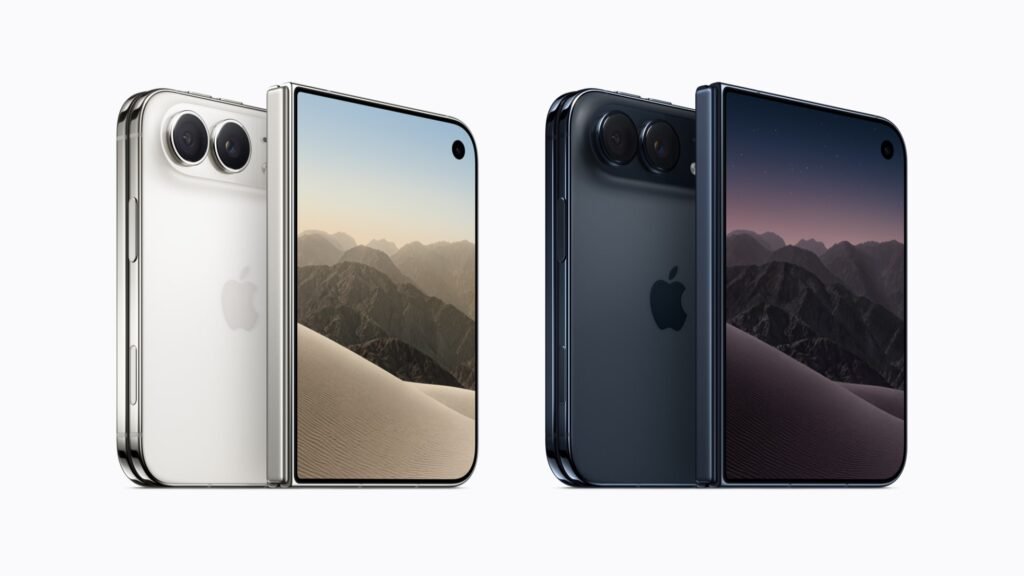
Image Credit: Apple official website
iPhone Duo is available in two refined colors: star white and night sky. Pre-orders begin Friday, October 16, with availability beginning Friday, October 23.
“iPhone Duo is the most transformational change to iPhone since the original. With an entirely new design and intuitive experiences, it shows what’s possible when hardware and software are engineered together and redefines what it means to use a foldable phone,” said John Ternus, Apple’s CEO. “With the largest display ever on iPhone that still fits easily in your pocket, combined with the power of A20 Pro, iPhone Duo helps you stay more immersed and productive wherever you go, whether you’re enjoying content, multitasking across apps, or gaming.”
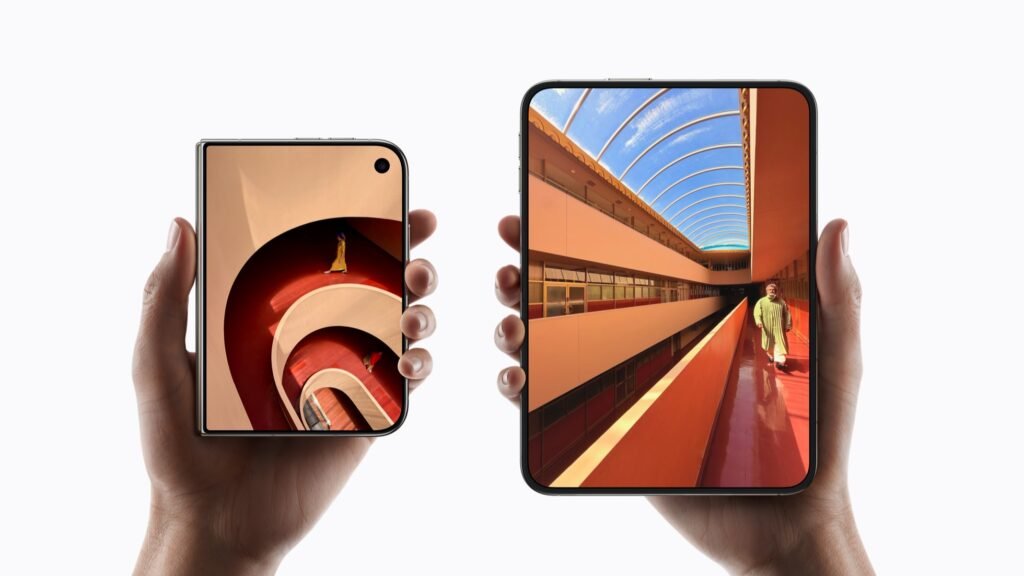
One More Thing: The iPhone Duo Unveiled
The keynote covered a lot of ground, the iPhone 18 Pro and Pro Max, a revamped Apple Health, the A20 Pro, the new C2 modem, and Apple Intelligence layered through nearly every demo. But the moment everyone had waited a decade for came at the end.
The iPhone Duo is Apple’s first foldable. It starts at $1,999 in the US for the 256GB model before state sales tax, and ₹2,99,900 in India. That Indian price is among the highest in the world for the device, and within hours of the announcement it had taken over Indian social media in a way no iPhone launch has managed before.
Before getting into the memes, though, it is worth understanding what Apple actually built, why the engineering is genuinely hard, and whether it justifies a phone that costs more than a new hatchback. For context, the top-end 2TB Duo at ₹4,49,900 costs about fifty thousand rupees more than a mid-variant Maruti Suzuki Alto K10 at Delhi ex-showroom prices.
iPhone Duo: Features, Hardware Engineering, OS Changes, and More
Few phones have leaked as thoroughly as this one. Design, hinge, battery architecture, display sizes, pricing, all of it circulated for well over a year while the industry called it the “iPhone Fold”. Now that units have been handled by reviewers at Apple Park, the picture is clearer, and mostly flattering.
Hardware
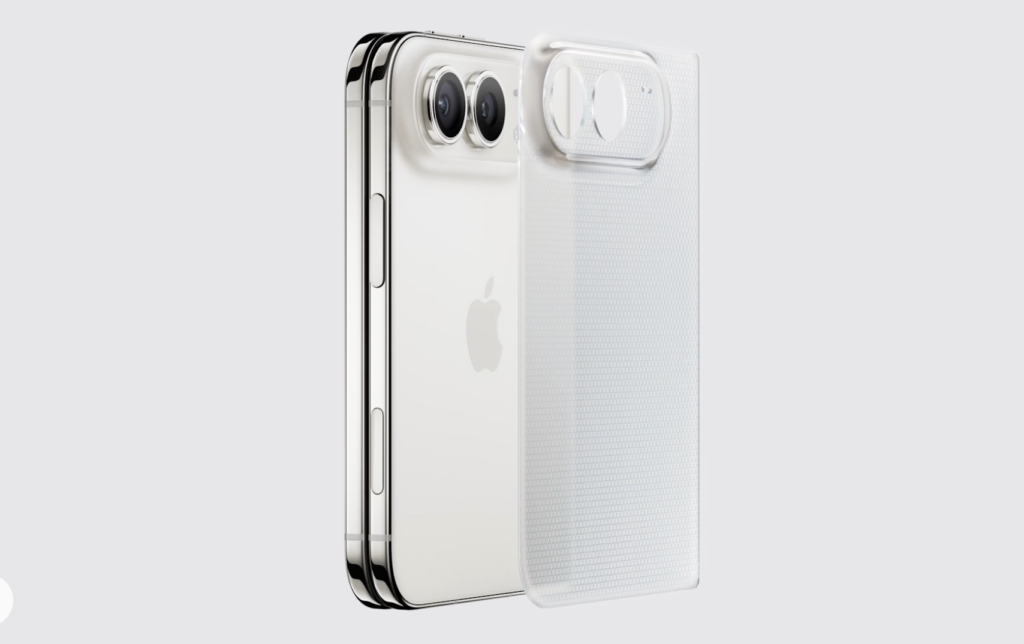
The enclosure is grade 5 titanium with a mirror-polished finish, paired with a 3D-printed hinge cover in a contrasting micro-blasted texture. Ceramic Shield protects the back; the front carries Ceramic Shield 2, which Apple rates at three times the scratch resistance of the previous generation. The Duo is splash-, water- and dust-resistant at IP68, tested to six metres for thirty minutes.
The hinge is the headline engineering story. It is built from more than 100 precision components that control the folding motion and hold the centre of the panel flat when open, and an integrated magnet array gives the close a deliberate, weighted click. Inside, support ribs stiffen the chassis and the antenna splits use ceramic fibre inserts to add rigidity, the kind of detail that only matters when you have removed half the structural spine of a phone to let it bend.
It is not the thinnest or lightest foldable on the market. Open, it measures 5.2mm and Apple calls it the thinnest iPhone ever made. Closed, it is 11.3mm and weighs 254g. Samsung’s Galaxy Z Fold 8 is both slimmer and roughly 50g lighter. Reviewers who handled both described the Duo as noticeably denser and more solid, which is a fair trade for some buyers and a dealbreaker for others.
Display Technology
The 7.6-inch inner panel is a Super Retina XDR display, 50 percent larger than the iPhone 18 Pro Max, built from ten ultrathin layers with a nano-texture matte finish that cuts glare, the same broad approach Apple uses on the Pro Display XDR, Studio Display and higher-end MacBook Pro configurations. Closed, the 5.4-inch outer display delivers about 90 percent of the screen area of an iPhone 18 Pro, so it works as a normal phone rather than a compromised cover screen.
Both panels share the same aspect ratio, which is why content scales cleanly as you fold and unfold instead of reflowing awkwardly. Both displays run ProMotion, support Always On, and hit 3,000 nits peak outdoor brightness. A FaceTime camera sits under the inner display and stays invisible until called.
The durability stack underneath is where the money went. A scratch-resistant coating sits over a nano-textured cover layer made from a custom polymer that Apple claims is up to 40 percent stiffer than industry-standard materials. High-strength glass sits above and below the folding panel, joined by custom adhesives engineered to let the layers glide past each other during a fold, Apple’s own analogy is pages in a book, which relieves bend stress that would otherwise show up as permanent distortion. A titanium plate at the base finishes the sandwich.
The result is the thing every foldable buyer asks about first. The Wall Street Journal’s Joanna Stern reported seeing no crease at all, even with the device partially bent. Tom’s Guide found it faintly visible but impossible to feel. Either way, it is a clear generational step past what Android foldables currently ship, and the matte finish is doing a lot of that work by refusing to reflect a line of light down the middle of the panel.
Apple Pencil support with USB-C is coming later this year, on either display.
iOS 27
Hardware this unusual is dead weight without software written for it, and iOS 27 is the most substantial rethink of the iPhone interface in years.
Lock Screen controls, the Home Screen dock, and app navigation move to the side of the display rather than the bottom, freeing vertical space for content. Open the Duo and you get two Home Screen pages, with Today View, a vertically scrolling column of widgets, on the left. The status bar becomes a circular, flexible element tucked into the corner. The Dynamic Island has been reoriented to sit vertically along the side of both displays, expanding for Live Activities and alerts.
More interesting is how the OS reacts to physical state. Content responds as the device folds, reorients when you turn it sideways, and moves to the appropriate display when you flip it over. Split View brings genuine side-by-side multitasking to iPhone for the first time, including two windows of the same app, two Safari windows for comparison shopping, for instance, and you can save app pairs to return to. StandBy also gets a major upgrade: set the Duo down and it becomes a photo frame, clock or widget hub on either display, even off charge, with new Calendar and Weather faces.
Apple has shipped updated APIs and SDKs, with iPhone Duo support coming to Device Hub in Xcode. Netflix, Zoom and Slack were demoed as launch-ready third-party examples.
Camera
The rear system is a 48MP Fusion Main plus a 48MP Fusion Ultra Wide, the latter shared with the iPhone 18 Pro models. The main sensor shoots up to 48MP with zero shutter lag, defaults to 24MP for a sensible balance of detail and file size, and includes an optical-quality 2x telephoto crop. It runs a new computational pipeline, and leans on a large sensor, fast aperture and sensor-shift stabilisation in low light. The Ultra Wide handles macro. Photographic Styles gains texture and grain controls.
Two front-facing cameras round it out: a Center Stage camera that can rotate the frame automatically so you never have to turn the phone for a landscape selfie, and the hidden FaceTime camera under the inner panel for propped-up, hands-free calls.
The genuinely new material is what the second screen unlocks:
– Smart Take runs on-device models on the A20 Pro to read the scene and fire the shutter automatically when everyone is posed, killing the self-timer scramble.
– Duo Preview puts a live preview on the outer display so your subject can see their own framing.
– Selfies can be shot on the far better rear cameras while you frame them on the outer screen.
– Kid Cue plays Peanuts animations on the outer display to get a toddler to look at the lens.
– Duo FaceTime lets someone standing next to you join the same call on the outer display instead of crowding into frame.
– Dual Capture in FaceTime streams front and rear feeds at once.
Video tops out at 4K120 in Dolby Vision on the main camera, with Cinematic mode effects now applicable after capture at up to 60fps. Audio Mix adds new algorithms that isolate music as well as voices, and time-lapse supports 4K Dolby Vision HDR, easier to use here because you can simply stand the phone up instead of carrying a tripod.
Battery Life
There is one high-energy cell on each side of the fold. Apple silicon and what it calls energy rebalancing algorithms make the two behave as a single battery, which is a neater solution than partitioning power by half.
Rated figures: up to 31 hours of video playback on the inner display, up to 44 hours on the outer, and up to 24 hours of typical mixed use per charge. Fast charging hits 50 percent in around 20 minutes wired, or around 30 minutes on a MagSafe or Qi2 charger.
Apple Silicon: A20 Pro
The Duo uses the same A20 Pro as the iPhone 18 Pro, built on a 2-nanometre process. The 6-core CPU is up to 20 percent faster than the A19 Pro, which Apple claims makes it the fastest CPU in any smartphone. The 7-core GPU is up to 40 percent faster and more efficient, the new Dual 16-core Neural Engine doubles compute for on-device AI, and unified memory bandwidth is up 50 percent.
The more consequential change is thermal. Apple built a chip package inspired by its M-series silicon that connects the A20 Pro directly to a custom vapour chamber, and the payoff is sustained rather than peak performance, up to 35 percent better sustained throughput than the iPhone 17 Pro. That matters for exactly the workloads a big folding screen invites: long gaming sessions, video editing, and continuous on-device AI. A new display engine drives both panels simultaneously.
Apple Intelligence and Siri AI
The Duo ships into the new Siri AI, which is rolling out in beta with iOS 27 from 14 September. This is the rebuilt Siri: conversational, aware of onscreen content, and able to draw on personal context across messages, mail and photos to answer questions or take action. There is now a dedicated Siri app with conversation history synced privately over iCloud, and you can write or edit text almost anywhere by describing what you want.
On the Duo specifically, the second display changes the interaction model, you can hold a conversation with Siri on one half of the screen while reading or working on the other.
Elsewhere, Apple Intelligence adds Spatial Reframing, Extend and an upgraded Clean Up for photo composition, photorealistic output in Image Playground with SynthID labelling coming later, and Notify Me in Safari for tracking page changes like restocks or price drops. Processing stays on-device where possible, with Private Cloud Compute handling the rest.
Two caveats worth knowing: Siri AI launches in English first, with French, Japanese, Korean, Portuguese and Spanish following in October, and it will not be available initially in the EU on iOS.
C2 Modem and Wireless
The Duo is eSIM-only worldwide. Apple’s stated reason is space, no SIM tray means more room for battery, and eSIM is now supported by over 500 carriers globally. iOS 27 also adds iPhone Handoff, which lets you move a single number between two iPhones on supported carriers, though that launches with only T-Mobile in the US and Telekom in Germany.
Connectivity runs on two Apple chips. N1 handles Wi-Fi 7, Bluetooth 6 and Thread. C2, Apple’s second-generation cellular modem, brings AI-driven improvements to call quality and reliability and finally adds mmWave 5G support in the US. Reported gains over the C1X sit around 50 percent faster performance with up to 15 percent lower battery draw, which, on a device with this much screen to feed, is not a footnote.
Accessories
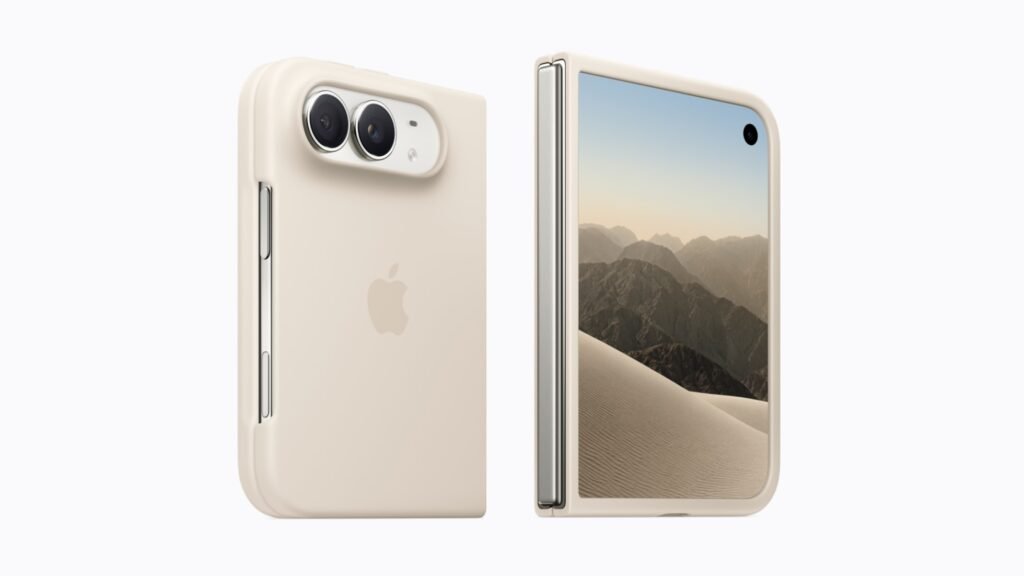
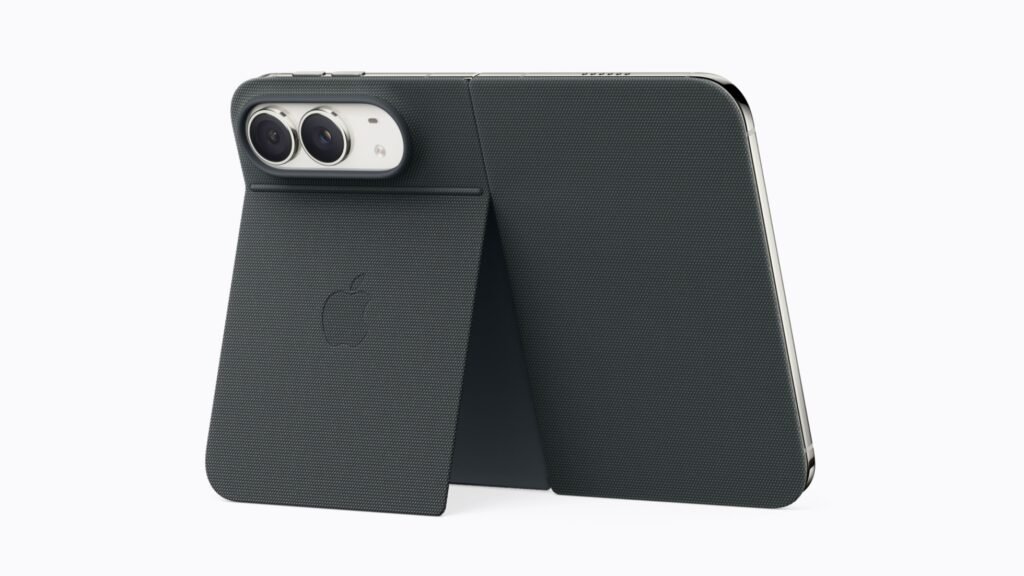
Two first-party options, both MagSafe, Qi2 25W and Qi-compatible:
– iPhone Duo Folio, $129, in navy blue and taupe, with an integrated kickstand that supports a wide range of viewing angles and folds flat when unused.
– iPhone Duo Case, $79, in sand and navy blue, a thin two-part design that wraps both halves.
Pricing
| Configuration | US | India |
| 256GB | $1,999 | ₹2,99,900 |
| 512GB | – | ₹3,24,900 |
| 1TB | – | ₹3,74,900 |
| 2TB | $3,199 | ₹4,49,900 |
Colours are star white and night sky. Pre-orders open Friday, 16 October across more than 70 countries including India, with availability from Friday, 23 October, and 28 more markets on 30 October. The Duo ships with iOS 27.1. In India, launch offers include bank cashback and trade-in credit; in the US, Apple has introduced a Klarna-backed leasing programme starting around $58 a month.
Competitors’ Products
Apple is arriving seven years after Samsung shipped the first Galaxy Fold, into a category that is no longer experimental.
- Samsung Galaxy Z Fold 8, launched 7 August 2026 at $1,899.99, and around ₹1,79,999 in India. Thinner and lighter than the Duo, with a redesigned wider body and a crease Samsung has meaningfully reduced, though not eliminated. The Z Fold 8 Ultra sits above it at $2,099.99 with an 8.0-inch inner display and a 200MP camera, and the Z Flip8 covers the clamshell end at $1,199.
- Google’s Pixel Pro Fold line, around $1,799, with IP68 rating and Google’s own Tensor silicon, and the closest Android analogue to Apple’s software-first pitch.
- Honor Magic V6, roughly ₹1,69,990, and spec-for-spec competitive with anything Samsung ships, with a design many reviewers rate as the best in the category.
- Motorola Razr Fold, $1,899, notable for a 6,000mAh silicon-carbon battery, 80W charging and stylus support.
- Vivo X Fold 5, Huawei Mate X7, not widely available in Western markets, but the Vivo matches Samsung on thinness with better battery and 100W charging, and Huawei has pushed ingress protection to IP58/IP59.
Apple is not winning on thinness, weight, charging speed or price. It is competing on the crease, on build quality, and above all on software, a version of iOS actually rewritten for the form factor, which is more than Android foldables have received from Google in seven years. Whether that is worth a premium of nearly ₹1.2 Lakhs over the Fold 8 depends entirely on which ecosystem you already live in.
Market Reaction
Reviewers were, on balance, impressed. Bloomberg’s hands-on described a satisfying magnetic close, no visible crease and software that handles the fold transition cleanly. Tom’s Guide called the display breathtaking while noting the weight penalty. The recurring theme across coverage is that Apple’s lateness bought it polish.
Wall Street was more divided. Apple shares actually closed marginally down on event day, then rose roughly 3 percent in the following session to trade near $327–333. Morgan Stanley noted that $1,999 came in well below the $2,300–2,500 many investors had expected, reading it as Apple choosing adoption over near-term margin. Citi held a Buy with a $365 target and called the Duo Apple’s biggest new hardware category since the Apple Watch and AirPods. Evercore ISI expects Apple to sell every unit it can build in the first six months; on their maths, capturing just 5 percent of Apple’s installed base is worth around $25 billion. Gene Munster doubled his estimate of the Duo’s share of FY2027 iPhone revenue from 5 to 10 percent.
In India, the reaction was almost entirely comedic. Within a day, timelines filled with salary comparisons, one widely shared post set the ₹2,99,900 price against a ₹3.5 lakh annual salary, working out to about 86 percent of a year’s earnings. Others pointed out you could buy a Royal Enfield Himalayan on-road and still have change. There were the inevitable “we have it at home” DIY foldable jokes, JerryRigEverything durability memes, and a three-way exchange in which Samsung roped Duolingo’s mascot into a joke about the Duo name.
The memes are funny. They are also a signal: an audience laughing about a price is an audience that has decided the product is not for them.
Price Increase of the Entire Apple Lineup
The Duo did not get expensive in isolation. The iPhone 18 Pro starts at ₹1,64,900 in India for 256GB, up ₹30,000 from the iPhone 17 Pro’s ₹1,34,900. The Pro Max moves to ₹1,79,900 from ₹1,49,900. That is roughly a 20 percent year-on-year increase on the Pro line, and Apple also raised prices on the outgoing iPhone 17 rather than discounting it, while skipping a base iPhone 18 entirely.
Two forces are behind this. The obvious one is positioning: with no base model, Apple has pushed the entry point to its current-generation lineup upward and is leaning into India’s fast-growing ultra-premium segment rather than defending the mid-flagship tier. The less obvious one is component cost. The industry-wide memory crunch, driven largely by AI infrastructure demand, has made RAM and NAND materially more expensive, and phones shipping larger memory pools to run on-device models are absorbing that first.
For what it’s worth, the iPhone 18 Pro is not a token upgrade, Apple quotes up to 24 hours of general use, 30 hours on the Pro Max, video playback up to 36 and 45 hours on eSIM-only models, and 50 percent charge in about 15 minutes. But a ₹30,000 jump is a ₹30,000 jump.
Pricing in India vs the World
At current rates, $1,999 is roughly ₹1.77 lakh before tax. The Indian price is ₹2,99,900. That gap is not arbitrary, and it is not purely Apple being opportunistic.
Three things drive it:
- First, the Duo is not assembled in India. Apple’s Indian manufacturing footprint has grown enormously and covers much of the standard iPhone lineup, but a first-generation foldable with a novel hinge and display stack is being built elsewhere, which means it lands as a fully imported device and attracts basic customs duty accordingly.
- Second, GST applies on top of the landed cost.
- Third, US prices are quoted before state sales tax, while Indian MRP is all-in, so the headline comparison overstates the gap somewhat.
None of which changes the lived reality for an Indian buyer. Where a US customer pays roughly the equivalent of a good laptop, an Indian customer pays what a small car costs. The iPhone 18 Pro at ₹1,64,900 versus $1,099 in the US shows the same pattern across the lineup.
The strategic question this raises is whether Apple’s India play has quietly changed shape. India is Apple’s fastest-growing market and its ultra-premium segment is expanding faster than any other, but that growth has come substantially from the previous-generation and base models sold on EMI, not from ₹3 lakh flagships.
Expect financing, trade-in and refurbished channels to do more of the heavy lifting than they ever have, and expect Samsung and the Chinese foldable brands to be very loud about their pricing over the next few weeks.
Final Words
So: will you be spending almost ₹3,00,000 on the new iPhone Duo, or watching from a distance and quietly wondering what people who buy these actually earn?
Tell us in the comments, what you make of the price hike, and whether an iPhone is anywhere in your plans this year.


