
The intriguing subject of whether mantras are language has been pondered by many bright minds for ages. Bīja and stobhas, which seem incomprehensible, are found in many mantras. Additionally, a lot of bījas are believed to sound like baby voices. Therefore, it may be assumed that stobhas and bījas are either meaningless or started as mood cues, however it is undeniable that many bījas were added later as a matter of ‘pattern completion.’ It is crucial that we examine mantras and language more closely and compare them in terms of syntax and semantics in order to answer the question, “Are Mantras Language?” Since many mantras are so understandable that they may be identified as language, it is imperative to start by talking about semantics. However, there are a lot of mantras that we cannot understand at all. Comparing mantras to language in other ways is fascinating. Unlike other Sanskrit terms, they do not diminish.
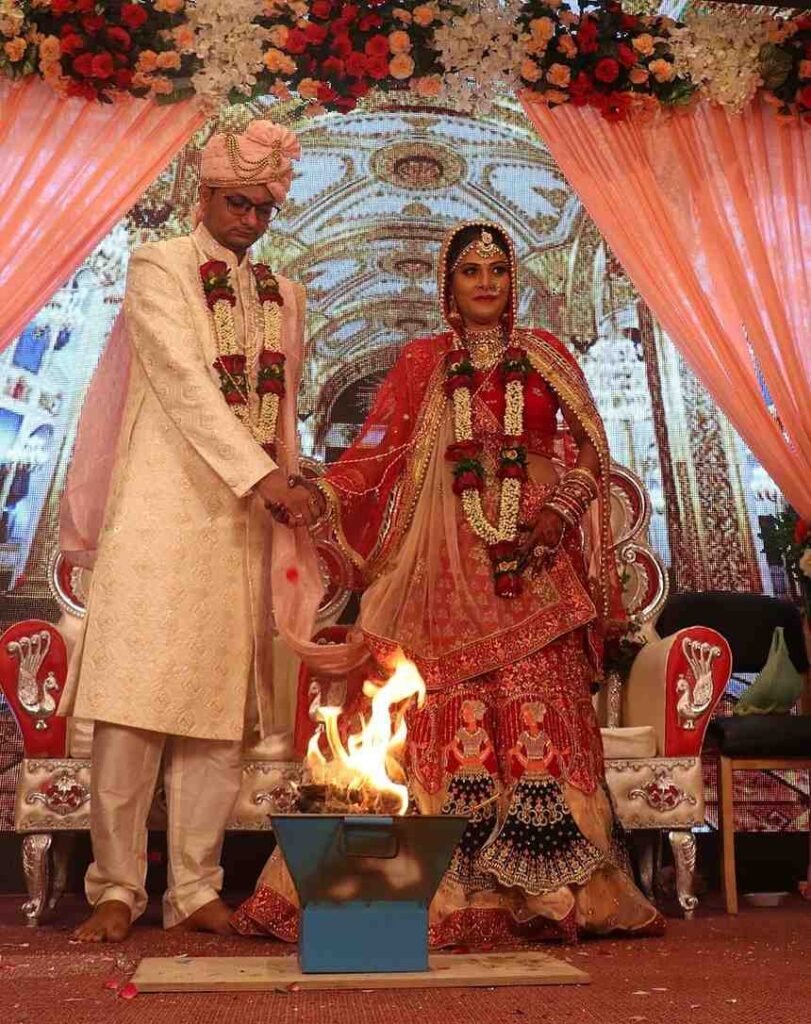
The relationship between language and mantra, however, can also be demonstrated in another way. If we use cinema as a subject, we can do it. The various camera types—such as wide shots, close-ups, and medium shots—have distinct functions in narrative and impact how viewers relate to people and events. Many filmmakers who want to depict the core of a marriage can accomplish so by including ‘Saat Phere’ or ‘seven circumambulations’ for at least ten or fifteen minutes. In order to convey the significance of a marriage, their cinematic codes will be constructed in a way that captures its essence. Here, the rituals captured in a spot (mise-en-scène,), gets communicated through mantras recited in Sanskrit at the backdrop (sound). Its objective is to bring out the soul of the marriage. The shots arranged in the desired manner in a film help presenting a vedic ritual like Hindu wedding effectively andprevent Sanskrit from declining.
Are Mantras Language? – Pre-linguistic Sounds
For centuries numerous intelligent minds have introspected an interesting question: Are mantras language? Many mantras contain bīja and stobhas which appear unintelligible. It is also found that many bījas resemble the utterance of babies. It may therefore be guessed that bījas and stobhas are either meaningless or originated as mood signals, though it cannot be denied that many bījas were later added as a matter of ‘pattern completion.’
Animals, too, utter such sounds. Scientists once believed that these sounds, especially those uttered by higher animals constituted some kind of language system. It is now realized that even if these sounds perform the function of ‘communicating’ they are so crude that can hardly be called language.
If animals function at the pre-linguistic level, it would be interesting to compare their utterances with sounds made by humans which are not part of their language. This means we have to find out if there are some definite patterns in mewing, neighing, bleating, cackling, grunting, twittering and chirping.
Even the laypersons can easily identify two structures, iteration and refrain. In fact, it is the repetitive feature which has given rise to onamatopoeiac words like caw, mew, and roar. If welisten carefully, we can also hear chorus and relay in a crude form.
Bird Songs
But it is the birds that offer a variety of acoustic structures, and much research has already been done in this area. The words ‘bird song’ may appear a caricature- it may not sound to all of us, but syntax it seems to resemble music rather than language.
We often hear the following sound patterns in the bird songs, though we may not be able to identify the birds who utter them.
1. A A A …
2. AB AB AB …
3. ABC ABC, …
4. ABA ABA, ABAABA …
where A, B, C are notes. All display iterations and refrains while the fourth also shows palindromes (which are also cycles)
However, bird songs are more complex than the above, and in order to appreciate its structure it is necessary to break them into basic units comparable to those of mantras. A few songs analyzed by François-Bernard Mâche are given below. The letters do not indicate notes but a group of notes which can be considered as a recurring unit.
1. A B C B C B D E /
B’ C B C B C B F E’
A B C B C D /
B’ C B C B C B F E’
(Black Flycatcher Ficedula hypleuca)
2. A B A B C A’ BB’ A’’ B’B
(Sylvia communies)
3. ABBC / AAAAB / ABCB / AAABCB / A
(A part of the song of Acrocephalus dumetorum)
These structures confirm what we ordinary people would expect from our own experiences related to simple notes.
Like other scientists, ornithologists have tried to search for meaning in bird songs. While in some cases they have been able to explain a correlation between the song pattern and its utility to function (feeding, courtship etc.), they realize that most songs have no function or goal. Birds sing because they feel like singing in much the same way we sing or play.
It is quite clear that bird songs and mantras resemble each other and bird songs fall in the same category of the rituals in general.
So, are Mantras Language?
In order to address the question “Are Mantras Language?” it is important for us to have a closer look at mantras and language and compare them of two aspects, syntax and semantics.
It is essential to discuss semantics first because many mantras are so intelligible, they can be recognized as language. On the other hand, there are many mantras which are totally unintelligible to us. Let us consider the following examples:
1.1 Saṅkalpa
Asya kumārasya upanayana kartu tatpracyangabhuta vapanadi kariṣye
(For the upanayana of this boy I undertake to complete all rituals. Shaving the scalp etc.)
1.2 om am hrīṃ koṃ / am yaṃ raṃ laṃ vaṃ ‘saṃ sam saṃ haṃ laṃ kṣaṃ ah / kroṃ hrīṃ aṃ hamsah soham/ devasya jīva iha sthitaḥ // Om am …
(From sri Ananta Vratam) 1.3 Om domvasasesejarropa om tyadacopra nah yo yod hi himadhisyavadergobha yam nirevatu vitsata, om lajvapra lajvapra yardama nria om rhaṃ auṃ oṃ, kyoṃ kaṃ srīṃ om // iti
(Brahmadanddaastra mantra) 1.1 shows a vow (saṅkalpa) to be taken by the father of the boy who is to be initiated into the upanayana, one of the sixteen saṃskāras.
1.2 These are the lines from Ananta (Gaṇeśa) pūjā. The verse relates to prāṇa pratiṣṭhā or infusing life force in the idol. Most of the words are unintelligible except the last few which indicate that god’s life force (jīva) is being ‘installed.’
1.3 Like I.2 these lines contain a number of bījas, but some words are certainly not the usual bīja mantras, nor do they convey any meaning. But if one inspects them carefully, they are found to be the inverses of meaningful mantras. For example, you will find the Gāyatrī mantra embedded in the inverted form (tayadacopra nah…)
We thus see two types of meaningless texts (1) those which contain bījas (2) those which are manipulations of the meaningful words. The second case is in fact a type of ritual syntax- permutations under ‘pattern completion’ which we have already considered. The inverted words are clearly treated as a separate genre.
In connection with śrauta rites Frits Staal, Founder and Emeritus Professor of Philosophy and South/Southeast Asian Studies at the University of California in Berkeley, furnishes graded illustrations, the first being completely intelligible while the last containing a sequence of ‘stobhas’ such as ha bu ha bu ha … In case of gṛhya rites that are practiced today, most mantras make sense while those which appear unintelligible are due to bījas (I.2 and I.3) which probably have tantric origin. However, when the Vedic mantras are used in the gṛhyarites, many times they appear to be vague or even out of context. It is said that the sixteen verses of the Hymn of Man from the Rig Veda used pūjā appeared totally irrelevant. The second and third step of ṣoḍaśopacāra are given along with the Vedic and Purāṇic mantras juxtaposed.
I.4 Second step: Seat (āsana) God is offered seat. (a) “The universe is nothing but this Man who is the ruler of immortality. It is because He willed so that He appeared through food needed for all creatures.” (RV 10-90-2) (b) “O God of gods. This diamond-studded seat of gold is offered to you in order to please you. Please accept it.” (Purāṇic)
Third Step: Offering water to God for washing his feet. (c) “His glory is indescribable. Man is greater than all the entire visible universe. All creatures are quarter of him; three quarters are what is immortal in heaven.” (RV 10-90-3). (d) “O God of gods. Our well being is result of your blessings. O the ruler of people. I offer you with devotion pādya (water) for washing your feet.” (Purāṇic)
In both the steps the Vedic mantras appear out of context while the Purāṇic mantras describe the rites.
We may say that this is the third type of meaningless variety in which the mantra per se has meaning but does not fit into the context.
Based on the terminology of ornithologists, Staal explains the distinction between śrauta rites and gṛhya rites. German bird watchers use the word Abetungsmoglichkeit (possibility to deduce) to indicate that a certain behaviour can be “explained.” Staal points out that this word is appropriate in case of the gṛhya rites but it cannot be applied to śrauta rites. Moreover, some mantras having tantric elements are meaningless and some (Vedic) may be out of step with the ritual acts relating to gṛhya ceremonies.
However, when we say that a bīja mantra has no meaning, we face a dilemma. It is said each bīja has a specific use. In fact according to a well-known śloka,
“Vaṣaṭ for influencing people), phaṭ for dislodging, huṃ for jealousy, kheṃ for causing injury, svāhā for winning favour, namaḥ for gaining a high post, and vauṣaṭ for wealth.”
Hence if we inspect a mantra, it is not difficult for us to ‘sense’ the meaning. Do we then have a right to say that the words like ‘phaṭ’ or ‘huṃ’ are meaningless? In the widest sense in which the word ‘meaning’ is used probably the answer is that they do convey some meaning to us. However, in a restricted sense the bīja do not have meaning because (1) Like other words they are not usually listed in ordinary dictionaries (2) They do not decline as other words do in Sanskrit. Their status is more like magical utterances which have specific purpose.
It is known that mantras have structured features of general rituals (GRS) such as iteration, refrain etc. These patterns are not found in language except in some verses.
For instance, such linguistic constructions would appear ridiculous.
1. I I I I I I am going to office (iteration)
2. A is working, B is working, C is working, D is working, E is working (refrain)
3. I am going am I (palindrome)
4. He went to school, he (cycle)
A strutterer may use 1, a clown may use 1,2, and 3, a poet perhaps 3 and 4 and we may all use 4 rarely for emphasis.
14. Suppose A, B, C constitute a team entrusted with a certain project. Their supervisor Senters the office and faces one of the following scenarios.
a. A, B, C tell S in unison, “We have completed 20% of the project. We need additional funds immediately” (chorus)
b. A “We have completed 20% of
B “the project. We need additional
C “funds immediately” (relay)
S is bound to feel either that he is ridiculed or that his juniors need psychiatric treatment.
It looks strange, but it is true, that while our social behaviour usually follows ritualistic pattern, our language has a different syntax.
It is interesting to compare mantras with language in other respects. When a literary work produced in one country reaches another country, it is usually translated so that it is intelligible to those who do not understand the language in which it was originally written. Thus the Bible, Das Kapital and Stephen Hawking’s ‘The Brief History of Time’ has been translated into a number of languages.
When mantras are exported, they are not translated, but transliterated, though they may undergo phonological adaptation in the new environment. If a work also includes non-mantric text, it is found that the text is translated while the accompanying mantras are transliterated. The ‘non-translatability’ of mantras is not confined to the bīja or stobhas, it is also applicable to mantras apparent meaning. For example, ‘Namo Buddhāya’ and ‘Śivāya namaḥ’ are not translated as “Hail to Buddha” or “Hail to Śivā,” but its original form is retained.
For instance, the Sanskrit mantra om vajra karma kam (Om thunderbolt rite) becomes in Japanese
On bazaar Kyarna Ken – their being 1-1 correspondence between the original words and those adapted to the Japanese environment.
Some other adaptations are; Sanskrit ‘mantra’ to Tamil ‘mantira,’ Sanskrit ‘homa’ to Japanese ‘goma,’ Sanskrit ‘bruh’ to Japanese ‘kham.’
There are other differences between language and mantras. There are three types of mantras, namely, japa, which is muttered, upāṃśu which are murmurs and the meditative mantras (Manasā) which are recalled in silence. Stall rightly refers to this gradation of intensity as a distinct characteristic of mantras not shared by ordinary language.
It is not difficult to guess how the mono-syllabic bīja emerged. They represent the remnants of sounds produced by our ancestors before language came into existence. Some evidence can be found in the utterances of babies. Prominent Russian Linguist and Literary Theorist called R. Jakobson had pointed out that the easiest or natural mode of sound production consisted in opening and closing of mouth. The emergence of sounds like om, him, hom can be easily ascribed to the baby’s earliest experiments with acoustics. More complicated syllables like lam, ram, clim, vam etc. possibly indicate the next stage of development in the hierarchy of utterances.
Staal rightly guesses that mantras appeared before language. It is said that rituals exist even among animals. The earlier monosyllabic sounds are quite handy to be used in ritual either alone or in conjunction with rites (ritual acts).
It would be worthwhile to briefly describe how the human child acquires language. The newborn has certain genetically transmitted capacities. His earliest ‘active’ contact with the world is through such responses as crying and wriggling in responses to the stimuli like hunger and pain. His primitive communication system is based on non-verbal conditioned reflex. For example, a touch on the shoulder may mean that he is going to be lifted by mother (or mother substitute). It is to be noted as well that nonverbal conditioned reflex constitutes meaning.
The first signals the infant can send has biological or physical connections with antecedents or consequences. His communication system is also iconic to some extent, there being some resemblance between the signal and its meaning. For example, the touch on the shoulder is a condensed form of the anticipated manipulation by mother. In fact, there arises a mutually ‘accepted’ communication system between the baby and the mother which consist of the baby’s understanding of the mother’s signals and the mother’s interpretation of the infant’s signals.
It is only when the child begins to ‘imitate’ adults that he picks up words through association though in a babyish way. Adults react to his incorrect pronunciation sympathetically and try to mimic him, from which arises the baby talk.
It is believed that the child does not learn words in the same sense as the adults regards them- components of language which can be fitted into various constructions. In the child’s repertory- called closed repertory- there are verbal signals which have 1-1 correspondence with meaning. He learns through the whole signals and not through the constituents. He does not know the complicated manner in which a word may be inflected or used in a sentence which is not part of his repertory. He may not even be familiar with the different intonations of ‘papa’ which are used on different occasions by grown-up children. It is only later that he begins to ‘analogize’ and can construct his own sentences. His repertory then becomes the ‘open repertory.’ This stage gives him a big leap forward in the acquisition of knowledge.
It is interesting to find that the names of the objects the baby first comes into contact are also the words that can be pronounced most easily, usually monosyllabic or bi syllabic.
Many psychologists have been influenced by Haeckel’s biogenic law according to which ontogeny (The development of the individual organism) recapitulates phylogeny (the development of the species). If we accept this law we can assert that mantras antedate language on two grounds.
1. The babbling and monologues of babies reveal that these utterances have resemblance with mantras and their ritualistic features. Babies often utter and iterate the sounds resembling the bīja and stobhas such as uṃ, hṃ, um …bā bābā…., go go go… etc.
2. There are also references to the abnormal ritualistic behaviour. According to the Freudian theory, the abnormal behaviour among the emotionally disturbed reflects the fixation at an earlier stage of the patient’s development. When the biogenic law is applied to this, the abnormal ritual behaviour which includes repeated mantra-like utterances as well as ties should be ascribed to the pre-linguistic stage in human evolution.
It is to be noted that Vedic society was non-literate and the Vedas were transmitted by oral tradition from one generation to another. Scholars have no doubt that the Vedic saṃhitās have been transmitted intact for two reasons. First, utmost care was taken in preserving the form (structure with pronunciation) and secondly, mnemonic methods were employed to ascertain that the original verses were not distorted.
However, the mantras used in the ritual context seem to have had a different fate. They could be broken into smaller pieces; these elements from different sources could be rearranged to form new mantras. Some of the smaller bits could be used as ‘fillers.’ What’s more, mantras originally meant for some purpose could be attached to other rites, appearing as foreign elements. Recall that the Hymn of Man was broken into pieces and attached to different steps of the ṣoḍaśopacāra puja. The peculiar ritual syntax allowing iteration, refrain, inversion (some points of the Gāyatrī have been inverted) implies that over several hundred years there was considerable distortion in the mantras used in ritual as well as the mantra – ritual act linkages.
Language, though it undergoes changes over time, is subject to different rules. The process of break-and-make does certainly not operate.
It is interesting to compare the Vedic mantras used in ritual with Purāṇic mantras and the mantras constructed in the recent years: the latter are more intelligible and seldom out of context. If distortion is treated as a function of time, the rite – mantra complex which appear intelligible today may appear strange after another thousand years.
While the fact that mantras antedate language is indubitable, Staal goes even further and asserts that language developed from mantras. He divides the mantras into three types. Type 1 represents the earliest stage of human development with the bīja and stobhas came into existence. The second type involved some syntactic constraints on type 1 mantras. The final stage shows mantras of Type 2 which appear more meaningful such as Vācam yaccha’ (control your speech).
There is another way by which the connection between language and mantra can be established. And this can be achieved if we study cinema as a subject.
Cinematic codes: Cinematic codes are the various visual and auditory elements that filmmakers use to convey meaning and evoke emotions in their audience. These codes include aspects like camera angles, lighting, sound, editing, and mise-en-scène, each playing a critical role in how a story is presented and understood. By analysing these codes, viewers can uncover deeper meanings and messages embedded within a film, connecting to the broader study of signs and meaning-making.
Five facts about Cinematic Codes:
1. Cinematic codes function as a visual language that filmmakers use to communicate with audiences without relying solely on dialogue.
2. Different camera angles can drastically change the viewer’s perception of characters and events, such as using a low-angle shot to make a character appear powerful.
3. Lighting is an essential code that can set the mood or tone of a scene; high-key lighting typically creates a cheerful atmosphere, while low-key lighting can evoke tension or fear.
4. Sound design complements visual elements by adding depth to scenes; for example, non-diegetic music can create emotional cues that enhance the viewer’s experience.
5. Understanding cinematic codes allows viewers to analyse films critically, recognizing how technical choices contribute to thematic elements and character development.
Different cinematic codes, such as camera angles, lighting, and sound design, collaborate to create a cohesive storytelling experience. For instance, a close-up shot can highlight a character’s emotions while dramatic lighting sets an intense mood. When combined with strategic sound design that emphasizes certain moments or themes, these elements guide the audience’s emotional response and understanding of the narrative. Manipulating cinematic codes allows filmmakers to influence how audiences interpret a film’s themes. For example, contrasting bright lighting with dark shadows might symbolize inner conflict or moral ambiguity. Similarly, using rapid editing during an action scene creates tension and urgency, while slow cuts can evoke reflection. This careful orchestration encourages viewers to engage with the underlying messages of the film on multiple levels. Sound design plays a pivotal role within cinematic codes by enhancing immersion and emotional resonance. For example, ambient sounds create a sense of realism that grounds viewers in the film’s world. Non-diegetic music often underscores critical moments, guiding emotional responses and making scenes more impactful. By carefully crafting soundscapes, filmmakers deepen audience engagement and facilitate a richer viewing experience that connects emotionally with the narrative.
Related Terms:
Mise-en-scène: The arrangement of everything that appears in the framing of a film, including settings, props, actors, costumes, and lighting.
Editing: The process of selecting and combining shots to create a coherent sequence, influencing the pacing and overall flow of a film.
Sound design: The creation and integration of audio elements in a film, including dialogue, sound effects, and music to enhance storytelling.
Cinematographic Codes: Cinematography codes are visual elements and techniques used in filmmaking that convey meaning and evoke emotional responses from the audience. These codes include aspects such as camera angles, shot composition, lighting, colour, and movement, which together create a visual language that filmmakers use to tell stories. By understanding these codes, viewers can interpret the underlying messages and themes presented in a film.
Five facts about Cinematography Codes:
1. Cinematography codes can significantly affect how an audience feels about a character or scene, using techniques like close-ups to create intimacy or wide shots to establish context.
2. Camera angles play a crucial role in shaping perspective; for example, low-angle shots can make a character appear more powerful or dominant.
3. The use of colour in cinematography can symbolize emotions or themes; for instance, red might represent passion or danger, while blue could convey calmness or sadness.
4. Lighting can manipulate shadows and highlights to create tension or emphasize certain elements within a scene, guiding the audience’s attention.
5. Different shot types (like long shots, medium shots, and extreme close-ups) help convey various aspects of a narrative and influence pacing and tone.
Cinematography codes greatly influence how audiences interpret film scenes by creating visual cues that guide emotions and understanding. For example, the choice of camera angles can shape perceptions of characters’ power dynamics, while lighting choices can evoke specific moods. When viewers recognize these codes, they become more engaged with the film’s narrative and can decipher underlying themes effectively. Colour usage in cinematography codes enhances storytelling by symbolizing emotions and reinforcing themes throughout the film. For instance, a predominantly warm colour palette may signify comfort and love, while cooler tones might suggest isolation or sadness. By strategically employing colours in different scenes, filmmakers can deepen viewers’ emotional connections to characters and their journeys, ultimately making the story more impactful. Camera movement plays a vital role in shaping narrative structure by influencing pacing and emotional resonance within a film. Techniques like tracking shots can create a sense of urgency or intimacy by following characters closely during critical moments. Conversely, static shots may evoke stillness or contemplation, allowing viewers to absorb key plot points. By carefully selecting camera movements throughout the narrative, filmmakers can craft a more immersive experience that guides audiences through emotional highs and lows.
Related Terms:
Framing: The way subjects and objects are arranged within the boundaries of a shot, influencing the viewer’s perception and focus.
Camera Movement: The various ways a camera can move during a shot, such as pans, tilts, or tracking shots, which can enhance storytelling and emotional impact.
Lighting Techniques: Different methods of illuminating scenes to create mood, highlight subjects, and influence how colours appear on screen.
Codes: In film language, codes refer to the systems of signs and conventions that filmmakers use to convey meaning and communicate ideas to the audience. These can be visual, auditory, or narrative elements that shape the viewer’s understanding of a film. Codes are essential because they create a shared language between the filmmaker and the audience, guiding interpretation and emotional response.
Five facts about Codes:
1. Codes can be explicit or implicit; explicit codes are clearly defined, while implicit codes rely on cultural context and audience familiarity.
2. Different genres utilize distinct sets of codes that help establish expectations for viewers; for example, horror films often use dark lighting and sudden sound cues.
3. Cultural codes are influenced by societal norms and values, meaning that films can have different interpretations across different cultures.
4. Filmmakers often play with codes to create subversion or irony, challenging audience expectations and prompting deeper engagement with the film.
5. Understanding codes allows viewers to analyse films more critically, recognizing how narrative, visuals, and sound work together to create meaning.
Codes function in film by providing a set of visual and auditory signals that guide how the audience interprets the story and its themes. They create a framework that helps viewers understand character motivations, emotional tones, and narrative progression. By recognizing these codes, audiences can engage more deeply with the film and appreciate its artistry in conveying complex messages. Cultural context plays a significant role in how film codes are interpreted by audiences in various societies. Codes that may be understood in one culture could be misinterpreted or overlooked in another due to differing societal norms, values, and experiences. This means filmmakers must consider their target audience when employing codes; what resonates in one culture might not have the same effect in another, leading to diverse interpretations of the same film. Subverting traditional film codes can significantly enhance audience engagement by challenging expectations and prompting viewers to think critically about the narrative. When filmmakers play with established codes—such as using unexpected plot twists or unconventional character arcs—they invite audiences to reconsider their preconceived notions about storytelling. This approach not only creates a more dynamic viewing experience but also deepens the narrative by encouraging viewers to explore underlying themes and messages beyond surface-level understanding.
Related Terms:
Conventions: Agreed-upon practices or techniques in filmmaking that help define a genre or style, such as typical narrative structures, character types, or visual aesthetics.
Symbolism: The use of symbols to represent ideas or qualities within a film, allowing filmmakers to convey deeper meanings beyond the literal narrative.
Mise-en-scène: The arrangement of all visual elements in a scene, including settings, props, actors, and lighting, which collectively contribute to the overall atmosphere and meaning of a film.
Codes in film theory: In film theory, codes refer to the systems of signs and conventions that filmmakers use to convey meaning and communicate messages to the audience. These codes can be visual, auditory, or narrative, and they help viewers interpret the film’s content and understand its underlying themes. The use of codes is fundamental in film semiotics, as it allows for a structured analysis of how films create meaning through established cultural and social conventions.
Five facts about Codes in Film Theory:
1. Codes can be both explicit and implicit; explicit codes are clearly defined elements like dialogue or visual symbols, while implicit codes may rely on cultural understanding or context.
2. Different genres of film have their own set of codes, which can include specific visual styles, narrative structures, and thematic elements that help establish audience expectations.
3. Cultural codes play a significant role in how viewers interpret films, as these codes are rooted in societal norms and values that can vary across different cultures.
4. Filmmakers intentionally manipulate codes to guide audience emotions, using techniques like camera angles, lighting, and sound design to evoke specific responses.
5. Understanding codes in film enhances critical viewing skills, allowing audiences to analyse not just what is presented on screen but also how it is presented and what it signifies.
Codes function as systems of signs that filmmakers use to communicate ideas and emotions to viewers. They guide audience interpretation by providing visual and auditory cues that signal deeper meanings or themes within the film. For instance, a close-up shot may evoke intimacy or urgency, while specific colour palettes can symbolize various emotional states. Thus, understanding these codes helps audiences engage with the film on a more analytical level. Genre-specific codes are crucial because they establish a framework within which audiences understand and anticipate certain elements of a film. For example, horror films often utilize dark lighting and suspenseful music as codes to create tension and fear. When audiences recognize these codes, they align their expectations accordingly, making their viewing experience richer as they actively engage with familiar conventions while also being open to subversion or innovation. Cultural differences significantly influence how audiences interpret film codes. For example, a gesture considered friendly in one culture may be viewed as offensive in another. This variance can lead to misunderstandings or misinterpretations when films cross cultural boundaries. An example is the use of colour; while white might symbolize purity in Western cultures, it represents mourning in some Eastern cultures. Filmmakers must be aware of these cultural codes to ensure their intended messages resonate appropriately with diverse audiences.
Related Terms:
Semiotics: The study of signs and symbols, and their use or interpretation in communication, including how meaning is constructed in film.
Genre: A category of film characterized by similarities in style, form, or subject matter, often guided by specific codes that define the expectations of the audience.
Intertextuality: The relationship between texts and how they refer or influence one another, often using shared codes that create connections for audiences.
Cinematography: Cinematography is the art and technology of capturing visual images for film and television. It encompasses various techniques, equipment, and styles that contribute to the storytelling process, making it a vital aspect of filmmaking that influences the viewer’s perception and emotional response.
Five facts about Cinematography:
1. Cinematography involves the use of various camera techniques such as framing, movement, and focus to enhance the visual storytelling.
2. The cinematographer, or director of photography (DP), collaborates closely with the director to ensure that the visual style aligns with the film’s narrative and emotional tone.
3. Different types of shots (like wide shots, close-ups, and medium shots) serve specific purposes in storytelling, influencing how audiences connect with characters and events.
4. Colour grading in post-production is an essential part of cinematography that can drastically alter the mood and aesthetic of the film.
5. The choice of lenses impacts depth of field and perspective, which can evoke different feelings in viewers or emphasize certain aspects of a scene.
Cinematography significantly shapes how audiences perceive a film by using techniques like camera angles, shot composition, and lighting to convey emotions and narrative details. For example, a close-up shot can create intimacy with a character, while a wide shot may emphasize isolation. These choices guide viewers’ emotional responses and enhance their engagement with the story being told. A cinematographer works closely with the director to develop a unified visual style that complements the film’s themes and story. This collaboration involves discussing camera techniques, lighting choices, and shot composition to ensure that each element aligns with the director’s vision. By blending their creative ideas, they create a consistent aesthetic that enhances narrative impact. Technological advancements have dramatically transformed cinematography by introducing new tools like digital cameras, drones, and computer-generated imagery (CGI). These innovations allow for greater flexibility in shooting styles and creative possibilities. As a result, modern filmmakers can experiment with unique visual techniques that enhance storytelling. The evolution of cinematography continues to redefine how stories are visually expressed in contemporary cinema.
Related Terms:
Camera Angles: The position and orientation of the camera in relation to the subject, which affects how the audience perceives the action and emotions on screen.
Lighting: The intentional use of light to create mood, highlight elements, and shape the visual narrative in a scene.
Shot Composition: The arrangement of visual elements within a frame, including subject placement, background, and foreground elements, which guides the viewer’s focus.
I would like to draw your attention to a Bollywood film called ‘Hum Aapke Hain Koun!’(1994) which presented Indian marriage on the screen by detailing fundamentally, by oneshot after another, series of elaborate ceremonies filled with deep cultural, spiritual and familial traditions. The duration of the film directed by Sooraj Barjatya was 3 hour 26 minutes. ‘Saat Phere’ or ‘seven circumambulations’ or ‘seven steps’ in Hindi/Sanskrit, a core Hindu wedding ritual where the bride and groom circle a sacred fire seven times, with each round representing a specific vow for a lifelong partnership, focusing on love, prosperity, strength, mutual respect, family and spiritual growth. It is the most crucial rite, symbolizing the completion of the marriage vows and the couple’s divine bond before God.
Weddings in India are festive occasions and usually celebrated with extensive decorations, colour, music, dance, outfits and rituals that depend on the community, region and religion of the bride and the groom, as well as their preferences. India celebrates about 10 million weddings per year, of which about 80% are Hindu weddings. Many Indian celebrities choose destination weddings, and the masses take inspiration from them. Both domestic and international destinations are popular for weddings in India. The destination wedding industry in India was estimated to cross ₹450 billion in 2020. Pre-wedding shoots along with wedding photography have also become a big stake in Indian weddings. Average wedding shoots can cost from ₹15,000 to ₹100,000 per day.
Since wedding or shaadi is an important custom in India, it is not surprising that filmmakers choose to present this Vedic ritual, with sounds of the mantras being played at the backdrop. We often see films coming to an end after the ‘Saat Phere.’ We also see promises being made and communicated to the audience by the actor and actress during ‘Saat Phere.’ ‘Saat Phere’ can also mean a turning point in a cinema. ‘Saat Phere’ is also associated with climax or anti-climax in a film. ‘Saat Phere’ is also presented to the audience in order to show increased linkage between two families as it emphasizes the connection between souls. It can also mean a new beginning. Thus, ‘Saat Phere’ means progress and by presenting it a film advances further.
Hence, Phere is by far the most important ceremony of the marriage as this is the marriage itself. The whole preparation has been to culminate into this event where the vows are taken, and marriage is solemnised in the presence of Devas, Pitras, relatives and friends as the august witness to this sacred event. It is totally managed by the Purohit and generally takes three to four hours, but under pressure from various quarters to get over with the ritual quickly many parts are skipped.
The guests depart by now and mostly the family members stay back for this ceremony. An area is prepared separately for this event, where arrangement is made for Pandit Ji to prepare Vedi and Havan Kund for solemnising the wedding. The Groom is now led to this mandapwhere knot with the life mate will be tied. The mandap is always well decorated and the seats of both Bride and Groom are royal. The mandap has four well decorated pillars. Traditionally, these were made from Banana trees, but nowadays pillars are decorated with colourful cloth and flowers are used. This is also called Chori.
It should be ensured that Purohit has prepared all the vedis and arranged all the pooja items in an orderly manner. Therefore, it should be ensured to get the Purohit on the job while other reception part is going on. The Purohit now starts chanting the shlokas to invoke and sanctify, Ganesh Ji, and Panch Deva on the Vedi with all 16 upcharas. Similarly, navgrah mandal is invoked and sanctified on a separate vedi. This is carried out by the Bride’s parents and the Groom. Groom’s parents can also partake in this pooja, however, in some families Groom’s mother does not take part in this event. That emanates from the warrior tradition when the mother would send the son to win the bride while she waits at home.
The Purohit then chant’s shlokas to invoke Lord Vishnu in the Groom. The bride’s parents now perform this poojan by applying Tilak and washing his feet with milk, with the sentiments of obeisance to the Groom who now represents Lord Vishnu. This is where the sacred purity of this ceremony is symbolised. Then follows the madhu parka rite. Bride’s parents offer the Groom, now Lord Vishnu, yogurt with honey, that is stirred three times with a coin, then sprinkled three times on the ground with that coin, which he then tastes thrice using that coin. That is followed by Nyas, a purification rite for the body as also establishing the mantra firmly in the body. Lord Vishnu is now sanctified in the Groom.
Now is the turn of the bride. A curtain is raised to protect the bride’s view while the bride is now led to the mandap by the maternal uncle. This curtain is called antarpat. Once seated the Antarpat is now raised, and both see each other for the first time during this event. They both now garland each other. However, nowadays this is sometimes done away with because, this has already taken place at the time of Jai mala. However, care be taken that Bride’s face is fully covered with Ghoonghat and her feet are covered in socks. This is done by the same chunni offered in Chunni ceremony and the socks brought by the groom’s family. Sometimes, a mukhota is carried to hide Bride’s face. But symbolically a paan leave can also be used to indicate the cover. Bride now is asked to offer Pooja to the present Devas on the vedis. Purohit then chants shlokas and invokes Lakshmi Ji in the Bride. If Groom’s mother is present, girl’s feet are washed, and she is sanctified as Lakshmi Ji by Groom’s parents.
Then comes the Pani Grahan also called Kanya Daan. During this rite, the Bride’s father offers her right hand to the Groom with the sentiment, “I am entrusting this Lakshmi Swarup bride as a wife to you, O, the Vishnu Swarup.” This is the most sacred part of the most sacred ceremony in Hindu Vivah Samskara, as Lakshmi and Narayan are actually invoked in the couple, rendering the whole rite into a divine sacrament rather mere customary ritual. The Groom replies, “maya-pi, pratigruhita”- I accept this.
Then the interesting vedic rite of Chheda Chhedi, also called Gath-Jora is carried out. In this one corner of the Bride’s Sari, is tied with a white or light-yellow cloth, upvastra, a long cloth worn by the Groom like a chunni. This is symbolic of two souls joining in one. Before tying the knot, five objects are placed in the knot, as a symbol of five prayers.
- A flower, to remain pure and blossomed
- Haldi, to grant good health for ever [Haldi is also symbolic of Gurubhav, not to have any inferiority complex]
- Akshat, rice grain, to grant a long-married life and to fulfil social and family responsibilities, as a couple
- Durva, to grant eternal freshness, symbolised by the greenery, as durva remains green even after drying. It is a symbolic prayer to provide eternal love and oneness between the couple.
- A coin, to provide wealth and riches of life, on which both the partners have equal rights.
Cheda-Chedi, or the Gath-Jora therefore symbolises a prayer for purity (flower), health (haldi), longevity (Akshat), eternal love and oneness (durva) and wealth (coin).
You may see that behind the ritualistic symbolism, there are heart-felt prayers and if done with passion and understanding have far reaching results. The Yagna fire is now kindled, and the couple performs four rounds of the Agni – the fire deity. In the first three rounds the bride leads the groom and in the fourth round the groom leads the bride. Before each round an offering is made to the Agni. This is called the mangal phere. The four rounds are symbolic of attaining the four endeavours of life; Dharma, Arth, Kama, Moksha. The symbolic truth to be accepted by both the bride and the groom is that their individual egos, separate identities have melted and become one in all the endeavours of life. The beauty of the vedic rites of first three rounds led by the bride are gentle reminder to equality and even superiority of the female in the worldly matters while keeping the yoke of moksha firmly in the hands of the male partner. This is the way prakriti and purusha meet.
Once four pheras are over, the couple is married!
While taking four rounds, the bride’s brothers(s), cousins are invited to please Agni Deva by offering Jau-Til [Barley and Sesame] in the Havan kund. By doing this they take a vow with every offering, to protect their sister’s saubhagya, with Agni Deva as witness.
After the mangal phera and the homa to the Agni Deva, the couple takes seven vows. These are traditionally taken while taking seven steps northwards. But there are other ways, like touching the seven lines made of wheat flour or touching seven beetle nuts, or seven small heaps of rice, with the bride holding the groom’s right toe and make it touch seven times in sequence as the vows are pronounced. The groom then does the same with the bride’s toe, after each vow, who are no embodiment of Vishnu and Lakshmi Ji. The vows to be pronounced are:
1. Aum ekamishe Vishnustva nayatu
“O Bride! I, the embodiment of Vishnu, grant you the care of rich heaps of food.”
She replies and vows, “You have kept under my care, wealth and food in your house, so I will
truly serve your parents, sister and others.”
2. Aum dve urjje Vishnustva nayatu
“O Bride! I, the embodiment of Vishnu, bring you here to strengthen my vigour, energy.” She replies and vows, “While nourishing my family I will strengthen its foundations, ever be sweet tongued, never utter a biting word. In adversity I will be forbearing, in your happiness happy, in your unhappiness unhappy.”
3. Aum trini rayasposhaya Vishnustva nayatu
“O Bride! I, the embodiment of Vishnu, make you the mistress of my wealth for our prosperity. She replies and vows, “I shall ever remain pure and never admit any other person into my mind.”
4. Aum chatvari mayobhavaya Vishnustva nayatu
“O Bride! I, the embodiment of Vishnu, bring you here for mutual happiness. She replies and vows, “All my adornments will be to please you”
5. Aum pancha pashubhyo Vishnustva nayatu
“O Bride! I, the embodiment of Vishnu, grant you the wellbeing of my cattle wealth and my property. She replies and vows, “I shall always devotedly worship Gauri for your wellbeing, and I shall always be devoted to you.”
6. Aum rutubhyo Vishnustva nayatu
“O Bride! I, the embodiment of Vishnu, grant you the pleasure of six seasons.” She replies and vows, “When you perform yagnas, offer oblations or alms, I shall be there next to you.”
7. Aum sakhe saptapado bhava sa mamanuvrata bhava Vishnustva nayatu
“O friend! I, the embodiment of Vishnu, request you to serve and follow me with fidelity in all the seven steps.
She replies and vows, “O Kulottma (the supreme in your clan)! My job is boundless, for you have become my husband and friend, with all these nobles present as witness, in a ritual performed strictly according to Vedic injunctions ordained by none other than Brahma the creator Himself.
Then using mango leaves, the groom sprinkles sanctified water from Kalash on the bride’s head, while the Purohit chants mantra conferring health on the bride.
You may notice the subtle change in addressing and accepting each other in the seventh step as friends [Sakha], the ultimate true relationship of Hindu Marriage.
What follows next is the time for Kansar. It is the time for Bride’s mother to bring flour, ghee and powdered sugar and keep these one by one in a plate. These are then mixed, and the Bride brings a bite to the Groom’s lips four times and then the Groom does the same to the Bride. It is not to be eaten. This is replaced by offering a piece of sweet peda to each and relishing it.
The Groom blesses the bride now offering the Saubhagaya Chinha, by putting the Kumkum vermillion powder or sindur at the parting of her hair or forehead. Some families also give her a mangalsutra at this time. These are the Saubhagaya Chinhas of a married woman. This is followed by offering of sindur and murmuring of blessings in Brides’s ear by saubhagyavati ladies [whose husbands are alive] from both families. “May you get the fidelity equivalent to that of Shiva-Parvati [the immortal eternally blessed couple on earth] in your mortal life” or such similar blessings are offered, one by one. It is customary also in some families to adorn the bride by Payal and Bichuas at this time by the maternal uncle and aunt.
It is customary to now offer a decorated chunni called Chainchi which is sewed with seven silver ghungroos and various other things in four corners. This is offered by one of the sons-in-law as protection to the bride. Groom’s father blesses the couple by brining their heads together tying them together in eternal bond of friendship.
If the wedding is at night and stars are visible, it is advisable to offer Dhruv Pooja by the couple. Simply standing the groom asks the wife to look at the Dhruv Tara [the star of steadfastness] and Arundhati [the star of devotion] and stay steadfast in her love and duty like Dhruva and be devoted like Arundhati is to Rishi Vishishtha. The bride in turn assures him she will follow their examples and remain devoted and steadfast in her love.
This completes the phere ceremony and marriage is now affirmed. They are now a couple, a family unit. Preparations are then taken up for Kanaya Vidai.
In addition to ‘Saat Phere,’ a Hindu marriage involves various rituals that include the recitation of mantras in Sanskrit, which aid in the proper execution of the ceremony. The mantras (as sounds) accompany the ritualsthat are part of the ceremony conducted at different spots (mise-en-scène). Hence, mantras play a key role in presenting a film about Indian wedding by communicating its essence to the audience. Films like ‘Hum Aapke Hain Kain’ (1994)” directed by Sooraj R. Barjatya broadly comes under this category.
The other rituals conducted in Sanskrit mantras include The Preliminary Rituals– Mangalaacharnam, Pavitrikaranam, Aachamanam, Shikhaavandanam, Praanayaamah, Nyaasah, Prithivee Poojanam; Var Satkaar– Aasan, Paadya, Arghya, Aachman, Naivedya-Madhuparka, Varan Sootra Dhaaranam, Chandan Dhaarnam, Yagyopaweet Dhaaranam, Kalashpoojanam, Deep Poojanam, Guru Poojanam, Gayatri Poojanam, Ganesh Poojanam,Gauri Poojanam, Sarvadev Namaskaarah, Shodashopachaar Poojanam, Swastiwaachanam, Rakshaavidhaanam, Vivaaha Ghoshnaa– Mangala Ashtakam, Paraspar Upahaar-Vastropahaar, Pushpophaar Maalyaarpan, Hastapeet Karanam, Kanyaadaan Guptadaan, Gaudaanam, Maryaadaakarnam, Paanigrahan, Granthi Bandhan, The Oath Taking Ceremony– Oaths for the Bridegroom, Oaths for the Bride, Yagya– Agnisthaapnam, Samidhaadhaanam, Jal Prasechanam, Aajyaahutihi, Gayatri Mantrahutihi, Praayashchitya Homah, Shilaarohanam, Laajaahomah Parikramaa, Saptapadi, Aasan Parivartanam, Paadprakshaalanam, Soorya Dhyaanam, Dhruva Dhyaanam, Shapath Aashvaasan, Sumangalee-Sindoor Daan, Mangal Tilakam, Yagya (Contd.) Swishtakrit Homah, Poornaahutihi, Vasordhaaraa, Neeraajanam-Aaratee, Ghrit-Avaghraanam, Bhasma-Dhaaranam, Kshamaa Praarthanaa, Saashtaang Namaskaarah, Abhishek Sinchanam, Visarjanam.
If a videographer is invited to capture a Hindu wedding in a detailed manner, then he/shewould adjust or handle the camera (technical device) accordingly. The video once prepared will have the above-mentioned rituals with mantras chanted by Purohit. This is because his/her objective is to present the authenticity of a Hindu marriage. Filmmakers also rely on the chanting of mantras in Sanskrit while presenting ‘Saat Phere’ in their films to the audience. Film directors may accommodate ‘Saat Phere’ in their script for a duration of ten to fifteen minutes. This is because Hindu marriages in court may be looked down upon by the audience until and unless the script demands it. Marriages in court are usually meant for couples who have eloped. Therefore, many film directors who may wish to show the essence of a marriage, can do so in their films by devoting at least ten or fifteen minutes to ‘Saat Phere’ in their movie. Their cinematic codes will be arranged accordingly with the aim to capture the essence of a marriage and efforts are put to communicate the meaningfulness of amarriage. Here, the rituals captured in a spot (mise-en-scène), gets communicated through mantras recited in Sanskrit at the backdrop (sound). Its objective is to bring out the soul of the marriage.
As I conclude, I would like to draw your attention to Christian Metz, a French film theorist, best known for pioneering film semiotics, the application of theories of signification to the cinema. He has thus contributed significantly to the study of signs and symbols in communication. He connected film theory with linguistic theories, arguing that films communicate meaning similarly to language through a series of codes and conventions. His insights helped shape the understanding of how viewers interpret visual narratives and the role of cinema in modern culture.
Five facts about Codes in Film Theory:
1. Metz proposed that films operate through a system of signs, similar to linguistic structures, allowing viewers to derive meaning from visual and auditory cues.
2. He emphasized the importance of genre in shaping audience expectations and interpretations, arguing that different genres utilize specific codes that viewers learn to recognize.
3. Metz’s essay ‘Language and Cinema’ (1974) introduced key concepts that bridged linguistic theory with film studies, making significant contributions to structuralism.
4. He explored the relationship between spectatorship and the cinematic experience, asserting that audience engagement is crucial for meaning-making in film.
5. His work laid the groundwork for later developments in film theory, influencing both academic discourse and practical approaches to filmmaking.
Christian Metz contributed to the understanding of film as a system of signs by linking it with semiotic theory, demonstrating that films communicate meaning through a structured system similar to language. He argued that viewers interpret films using established codes and conventions, allowing for an analysis of how meaning is constructed and understood. This perspective helped establish a foundation for analysing films beyond mere narrative content.In Metz’s theory, genre plays a significant role as it sets specific expectations for the audience regarding the film’s content and style. Each genre employs unique codes and conventions that guide viewers in their interpretation. By recognizing these elements, audiences can engage more deeply with the film’s narrative, leading to a richer understanding of its themes and messages. Metz’s focus on genre highlights the importance of cultural context in shaping viewer responses. Metz’s impact on contemporary film theory is profound, as his work laid the groundwork for integrating semiotics into film studies, influencing how scholars analyse visual media. His theories continue to be relevant in modern cinematic analysis, particularly in discussions about representation, narrative construction, and audience reception. By emphasizing the interplay between language and cinema, Metz’s ideas encourage ongoing exploration of how films convey meaning and engage viewers on multiple levels, enriching the field of media studies
Related Terms:
Semiotics: The study of signs and symbols, focusing on how meaning is created and understood in various forms of communication, including film.
Narrative Structure: The organized framework that shapes the story being told in a film, encompassing elements like plot, character development, and thematic elements.
Psychoanalysis: A psychological approach that explores the unconscious mind and its impact on behaviour, often applied to understanding audience reactions to film narratives.
REFERENCES
1. Burde, Jayant. Rituals, Mantras and Science- An Integral Perspective. Delhi: Motilal Banarsidass, 2004.
2. G, Anil. Hindu Marriage- Customs & Rituals. Chennai: Notion Press, 2022.
3. Brahmavarchas. A Manual of Hindu Marriage. Mathura: Yug Nirman Yojana Vistar Trust, 2011.
4. Pandit ShriRam SharmaAcharya. A Manual of Hindu Marriage. Haridwar: Shantikunj, 1997.
5. Roberge, Gaston. The Subject of Cinema. Kolkata: Seagull Books Private Limited, 2005.
Get Latest News Live on Storify News along with Breaking News and Top Headlines from US News, Trump News, Taylor Swift and Travis Kelce, Kamala Harris, Entertainment, Technology and around the world.


