
New Delhi, January 21: Delhi continued to experience very poor air quality on Wednesday morning, with the Air Quality Index (AQI) recorded at 341 around 7:00 AM, according to data from the Central Pollution Control Board (CPCB). While the pollution levels showed a slight improvement compared to Tuesday’s AQI of 397, air quality across the national capital remained a serious concern.
Prolonged exposure to such pollution levels poses significant health risks, especially for children, senior citizens, and people suffering from respiratory or heart-related conditions. Health experts advise limiting outdoor activity during peak pollution hours.
Pollution Hotspots Across Delhi
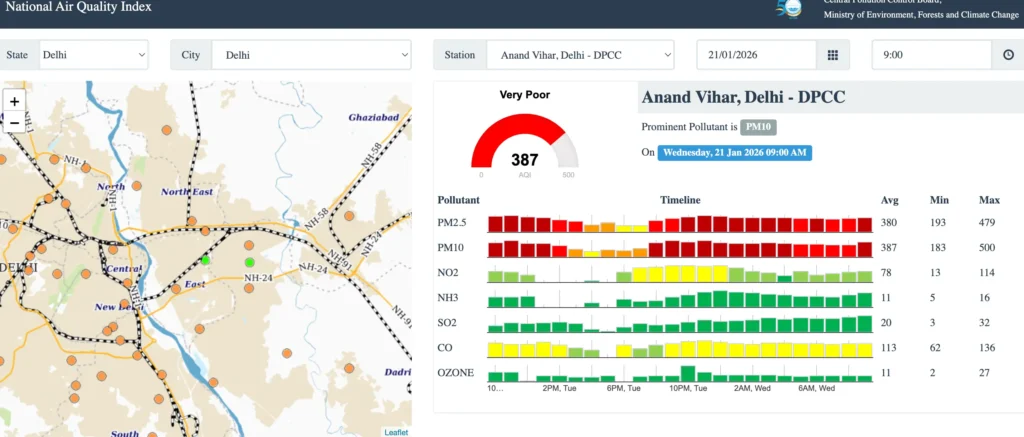
Several monitoring stations across Delhi continued to report very poor AQI levels, indicating widespread pollution:
- Anand Vihar: 388
- Ashok Vihar: 388
- Wazirpur: 386
- Punjabi Bagh: 374
- RK Puram: 377
- Bawana: 383
- ITO: 369
- Chandni Chowk: 369
- Dwarka Sector 8: 376
These readings underline the uniform spread of air pollution across residential, industrial, and commercial areas of the city.
Understanding AQI Levels
As per official classification standards:
- 0–50: Good
- 51–100: Satisfactory
- 101–200: Moderate
- 201–300: Poor
- 301–400: Very Poor
- 401–500: Severe
Delhi’s current AQI firmly places it in the ‘Very Poor’ category, just a step below ‘Severe’.
Weather Conditions Add to the Challenge
The India Meteorological Department (IMD) reported moderate fog across several parts of Delhi, with dense fog at isolated locations. The temperature hovered around 9°C in the early morning, worsening visibility and trapping pollutants close to the surface.
GRAP Measures and CAQM Update
In response to the deteriorating air quality, the Commission for Air Quality Management (CAQM) had earlier enforced Stage IV of the Graded Response Action Plan (GRAP) across Delhi-NCR. However, the commission has since revoked its January 17, 2026 order, as Stage IV measures apply when AQI crosses 450, categorised as ‘Severe’.
Authorities have directed all implementing agencies to remain on high alert and strictly enforce measures under Stage I, II, and III of GRAP to prevent further deterioration. Continuous monitoring and periodic reviews will remain in place across the National Capital Region.
Public Advisory
Residents are advised to:
- Avoid prolonged outdoor activities
- Use masks when stepping outside
- Follow official advisories related to pollution and health
Disclaimer
This article is published by Storify News as a rewritten and restructured report based on publicly available information and official data releases. Storify News is a digital news aggregator and does not conduct original field reporting. The content is intended solely for informational purposes.


