
A few years back the process of coming up with a new medicine involved spending almost ten years on research, testing out thousands of molecules, and pouring in billions of dollars with no assurance of success.
Now, Artificial Intelligence (AI) is altering that story.
Rather than having scientists manually analyze millions of biological data points, AI is able to detect patterns, predict which drug candidates will be successful, and even suggest possible treatments within days rather than months.
That is the reason why AI has become one of the major drivers of growth in India’s biotechnology industry.
India is already one of the world’s most rapidly growing biotechnology markets.
Government Recent Development
The Government of India states that the bioeconomy in the country amounted to 195.3 billion US dollars in 2025, this representing an increase from 165 billion US dollars in 2024, a yearly growth of almost 18%. The government intends to have a bioeconomy worth 300 billion US dollars by 2030 by means of research, innovation, and the use of advanced technologies such as Artificial Intelligence.
So what is the exact place of AI in biotechnology?
Consider biotechnology as a means of solving biological problems, whereas AI functions as an intelligent assistant.
AI is able to study vast quantities of genomic data, medical records, results from laboratory experiments, protein structures, and findings from clinical trials much more quickly than humans can. Researchers then apply these insights in order to create smarter medicines, personalized treatments, better vaccines, and improved crop varieties.
Rather than taking the place of scientists, AI assists them in making quicker and more accurate decisions.
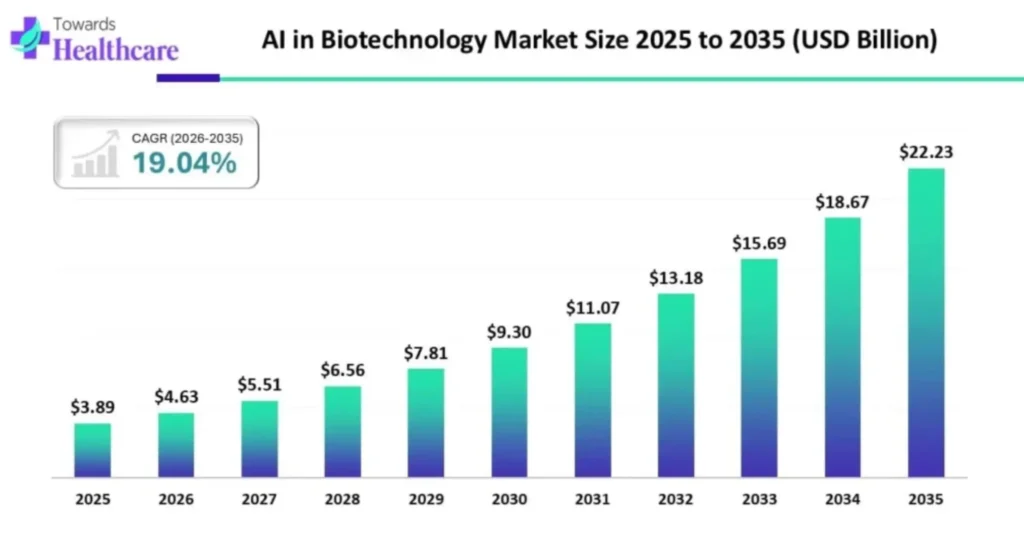
According to Towards Healthcare Research and Consulting, the AI in biotechnology market size reached US$ 3.89 billion in 2025 and is anticipate to increase to US$ 4.63 billion in 2026. By 2035, the market is forecasted to achieve a value of around US$ 22.23 billion, growing at a CAGR of 19.04%.
The healthcare sector might be undergoing its most significant transformation.
Indian researchers are now more and more using artificial intelligence in order to identify disease biomarkers, predict patients’ responses to treatment, and analyse medical images for conditions such as cancer, cardiovascular diseases, and rare genetic disorders.
With the launch of initiatives such as Genome India, which has made available for research genomic data from 10,000 Indians, AI now has access to valuable datasets that can speed up the development of precision medicine tailored to India’s diverse population.
The field of drug discovery is also undergoing rapid change.
In the past, pharmaceutical companies examined millions of compounds before they came across a drug that showed promise.
At present, AI algorithms are able to predict how molecules will behave, identify compounds that show promise, estimate their toxicity, and even suggest improved drug designs before any laboratory testing takes place.
It greatly lowers the costs of research and at the same time increases the likelihood of a successful drug development process.
Agriculture is likewise enjoying the benefits of biotechnology driven by AI.
Scientists are applying artificial intelligence in order to improve the quality of seeds, to identify crops that are resistant to disease, to optimize the use of fertilizers, and to keep an eye on the health of crops by means of satellite imagery and sensors.
As the effects of climate change carry on for farming, the use of AI-powered biotechnology is becoming necessary if food security is to be improved and the environmental impact reduced.
Seeing that this was an opportunity, the Indian government has begun to make heavy investments in biotechnology driven by AI.
Recent Collaboration
A collaboration has been reached between the Department of Biotechnology (DBT) and the Ministry of Electronics & Information Technology (MeitY) for the purpose of establishing an AI-powered biological research ecosystem. As part of the IndiaAI initiative, researchers are given access to sophisticated computing facilities, and the DBT provides large biological datasets for use in AI-based research.
A major milestone is the BioE3 Policy.
The policy is concerned with biotechnology in the areas of the economy, the environment, and employment by encouraging AI-powered Biofoundries, Bio-AI Hubs, precision biotherapeutics, sustainable biomanufacturing, climate-resilient agriculture, and next-generation bio-based industries.
The aim of these initiatives is to boost India’s innovation ecosystem and to open up new opportunities for startups and researchers.
Indian biotechnology startups are likewise adopting AI at a impressive rate.
Companies are creating AI platforms for use in the areas of drug discovery, molecular diagnostics, digital pathology, synthetic biology, protein engineering, and clinical decision support.
Investor interest in the combination of biotechnology and artificial intelligence is growing as it enables Indian innovations to compete on a global scale.
The journey does have its difficulties.
AI systems need huge amounts of biological data that is clean, standardized, and of high quality.
Healthcare data records still tend to be scattered among hospitals, laboratories, and research institutions, which makes it difficult to integrate them.
Concerns also exist as to data privacy, cybersecurity, the ethical use of AI, regulatory approvals, and the fact that there is a shortage of experts who understand both biotechnology and artificial intelligence.
Only by dealing with these issues can AI’s full potential in the life sciences be realised.
Advantages of AI in India’s Biotechnology Market
- Speeds up drug discovery and vaccine development
- Improves disease diagnosis and precision medicine
- Reduces research costs and laboratory workload
- Enhances agricultural biotechnology and food security
- Accelerates genomic and protein analysis
- Supports sustainable biomanufacturing
- Encourages biotech startups and innovation
- Creates high-skilled employment opportunities
Challenges and Limitations
- Limited availability of high-quality biological datasets
- Data privacy and cybersecurity concerns
- High computing infrastructure costs
- Shortage of AI-biotechnology professionals
- Regulatory uncertainty for AI-driven healthcare solutions
- Risk of algorithmic bias if training data is incomplete
- Smaller biotech companies may struggle with AI investments
The narrative surrounding biotechnology in India is not merely one that involves laboratories and research papers anymore.
It is turning into a tale of intelligent algorithms working with scientists to develop medicines more quickly, increase crop productivity, produce sustainable bio-products, and enable healthcare to become more personalized than ever before.
If India continues to invest in AI infrastructure, in skilled personnel, in research collaboration, and in responsible regulation, it has the possibility of becoming one of the world’s leading innovation hubs for AI-powered biotechnology.
The future of biotechnology in India will not be shaped by biology alone; rather, it will be driven by biology, data, and Artificial Intelligence all working in conjunction.


