
NEW DELHI — In a significant Union Cabinet realignment, Prime Minister Narendra Modi entrusted senior leader and five-time Lok Sabha MP Pralhad Joshi with the Union Ministry of Education. Joshi took charge following the resignation of Dharmendra Pradhan, assuming leadership at a critical juncture marked by nationwide examination reforms and the ongoing rollout of the National Education Policy (NEP) 2020.
Known as one of the government’s premier troubleshooters and parliamentary strategists, Joshi brings over two decades of legislative experience to Shastri Bhawan. Below is a data-oriented analysis of why Prime Minister Modi chose the veteran MP from Dharwad to head India’s education portfolio.
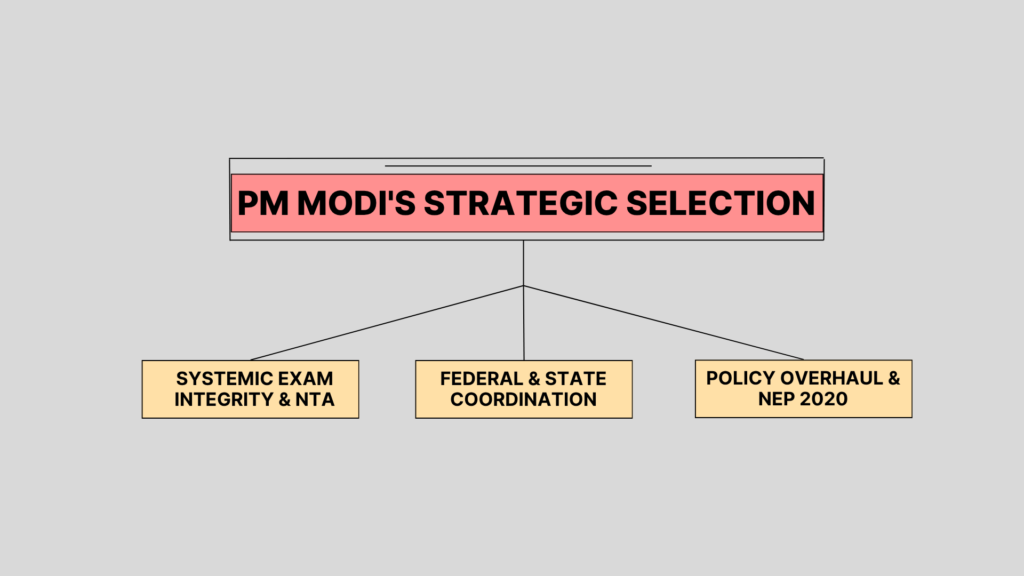
Key Highlights & Strategic Drivers
- Troubleshooting & Crisis Management: Proven track record in navigating complex legislative and administrative stalemates.
- Institutional Overhaul: Entrusted with reforming the National Testing Agency (NTA) and restoring public trust in national entrance exams.
- NEP 2020 Execution: Transitioning policy objectives into federal and state-level execution.
- Seniority & Track Record: 5-term Lok Sabha MP (Dharwad, Karnataka) with prior Cabinet experience in Parliamentary Affairs, Coal, Mines, and Renewable Energy.
Deep Dive: The Core Reasons Behind the Appointment
1. High-Stakes Crisis Management and Institutional Repair
The Ministry of Education faced intense public and political scrutiny over examination integrity and the structural functioning of the National Testing Agency (NTA). Restoring credibility among millions of students requires an administrator capable of enforcing strict regulatory safeguards and overhaul measures.
Joshi’s career in government has consistently centered around high-stakes management:
- During his tenure as Union Minister for Parliamentary Affairs (2019–2024), he steered crucial legislative proceedings through both Houses of Parliament.
- In the Coal and Mines Ministry, he oversaw structural shifts that boosted domestic production and improved supply-chain transparency.
His appointment signals an emphasis on administrative accountability, technological safeguards, and institutional governance within the national examination ecosystem.
2. Parliamentary Mastery and Multi-Stakeholder Consensus
Education in India is a Concurrent List subject, requiring seamless coordination between the Centre and various state governments. The implementation of the National Curriculum Framework (NCF) and university accreditation reforms demands continuous dialogue across political spectrums.
| Factor | Governance Metric | Impact on Education Ministry |
| Legislative Experience | 5 consecutive Lok Sabha wins (2004–Present) | Strong institutional authority in Parliament. |
| Cross-Party Mediation | 5 years as Parliamentary Affairs Minister | Capacity to build consensus on state-level NEP adoption. |
| Executive Portfolios | Consumer Affairs, Renewable Energy, Coal, Mines | Proven execution in large, complex ministries. |
3. Transition from Policy Design to On-Ground Delivery
The initial phase of NEP 2020 focused on framework design, curriculum revision, and foundational literacy benchmarks. The current phase demands operational discipline:
- Digital Infrastructure Expansion: Scaling up national platforms like DIKSHA and SWAYAM.
- Higher Education Integration: Streamlining accreditation models and expanding international campus partnerships.
- Vocational Skill Integration: Aligning school education with market-oriented skill sets.
Joshi’s background in overseeing multi-billion-dollar infrastructure schemes—such as the PM Surya Ghar initiative in Renewable Energy—provides the administrative background required for large-scale program execution.
Pralhad Joshi’s Key Priorities Ahead
“I accept this responsibility with a sense of duty and humility… Under the guidance of the Prime Minister, I will work to the best of my ability to strengthen India’s education system.”
— Pralhad Joshi, Union Minister of Education
- Restoring Exam Credibility: Implementing tight technological protocols and oversight mechanisms for national entrance tests.
- NTA Restructuring: Streamlining operations, reducing paper-based vulnerabilities, and moving toward computer-based evaluation frameworks.
- NEP 2020 Completion: Ensuring smooth adoption across higher education institutions and school boards nationwide.
- State-Level Alignment: Engaging constructively with non-BJP ruled states to ensure uniform educational standards.


