
Every conflict reveals a new method of murdering and maiming soldiers. In the 16th and 17th centuries, gunpowder made it possible to, regrettably, kill a large number of adversaries with a single offensive weapon, an artillery round. In the end, it was shown during World War II that an atomic weapon could eliminate over 100,000 enemy soldiers with a single usage. Throughout the 17th and 20th centuries, the effectiveness of maiming and killing increased gradually; but, during World War I, the use of inhaled toxic gases caused an order of magnitude increase.
The widespread employment of chemical weapons, or simply “gas,” was one of the lasting characteristics of World War I. The “psy-war,” or terror element, was powerful even though chemical warfare accounted for less than 1% of the war’s overall casualties. As a result, the Geneva Protocol of 1925 outlawed chemical warfare using gases. Due to their peaceful applications, several of these hazardous substances are still produced today. For instance, phosgene, or carbonyl dichloride, is an industrial reagent and a precursor to medicines and other significant organic molecules.
During World War I, a number of chemicals were used into weapons. In August 1914, France used tear gas, which was actually the first time it was used. The chemical utilized was either ethyl bromoacetate, which is described as “fruity and pungent,” or xylyl bromide, which is described as smelling “pleasant and aromatic.” Both are colourless liquids that must be atomized in order to be distributed as weapons. They irritate the eyes and induce uncontrollable tears since they are lachrymatory agents. Temporary blindness may result with large dosages. Breathing becomes challenging if they are inhaled. After contact, symptoms normally go away within half an hour.
Fritz Haber (1868–1934) oversaw the German chemical warfare program. In April 1915, he introduced chlorine at Ypres as his first attempt at a weapon. Chlorine is a diatomic gas that has an odour that has been compared to a “mix of pineapple and pepper,” is light green in colour, and is around 2.5 times denser than air. It can react with water in the lungs to produce hydrochloric acid, which is tissue-destructive and can cause death or, at the very least, irreversible lung tissue damage and impairment.
Coughing, vomiting, and eye discomfort can occur at lower doses if it does not really enter the lungs. When unprotected soldiers were exposed to chlorine, it was fatal. Over 1,100 people are said to have died on its initial deployment at Ypres. Ironically, the Germans gained little ground since they were unprepared for its effectiveness and couldn’t take use of their advantage.
The benefits of chlorine were transient. Chlorine’s colour and smell made it simple to identify, and even soldiers without gas masks could lessen its effects by covering their mouths and nostrils with cloths soaked in water, even urine. As the British discovered when they tried to employ chlorine at Loos, releasing the gas in a cloud also presented challenges. As the wind changed, the gas returned to their own soldiers.
Haber’s next option was phosgene (carbonyl dichloride), which was most likely first employed by the Germans at Ypres in December 1915. Phosgene is a colourless gas that smells like “musty hay,” but the concentration needed to be at 0.4 parts per million, or several times the threshold at which negative effects happen, for the odour to be noticeable. Because it may react with proteins in the lungs’ alveoli to damage the blood-air barrier and cause asphyxia, phosgene is extremely hazardous.
Compared to chlorine, phosgene was far more lethal and effective, but it had the disadvantage that symptoms might occasionally take up to 48 hours to appear. The lachrymatory effects are the least severe initial consequences. But later on, it results in pulmonary edema, a buildup of fluid in the lungs that is fatal. Up to 85% of the 91,000 gas deaths during World War I are thought to have been caused by phosgene or the related substance diphosgene (trichloromethane chloroformate).
“Mustard gas,” or bis(2-chloroethyl) sulfide, was the most widely utilized gas during World War I. This is colourless in pure liquid form, but during World War I, impure variants with a mustard colour and a garlic or horseradish-like smell were utilized. It is a potent vesicant (blister-forming agent) and irritant that, upon contact, produces chemical burns with yellow fluid seeping from blisters. When skin irritation develops after initial contact, it is too late to take precautionary action. Although the death rate from mustard gas was just 2-3%, those who experienced breathing issues and chemical burns required lengthy hospital stays, and even those who survived were believed to be more likely to acquire cancer in the future.
Irritants such as chloropicrin, diphenylchlorarsine, American-developed Adamsite(diphenylaminechlorarsine), and others might get around gas masks and force soldiers to take them off, exposing them to chlorine or phosgene.
The usage of gases in combination was common. Artillery shells were the primary means of delivering gas. Inside the warhead, the agent or agents were in liquid form in glass vials that would shatter upon impact and dissipate. The Germans instituted a system of colour-coding shells. The pulmonary agents: chlorine, phosgene, and diphosgene were present in Green Cross shells. The tear gasses belonged to the White Cross. The “mask breakers” used by Blue Cross included chloropicrin. Mustard gas was used by Gold (or Yellow) Cross.
In hindsight, it is disheartening to realize that the Hague Convention of 1899 forbade the use of poisoning troops in conflict, which was so vicious, intimate, and unrestrained on both sides during World War I. The story of Fritz Haber, the German chemist who created phosgene and the “Haber Process,” which enabled the fixation of atmospheric nitrogen into ammonia-based fertilizer, graphically illustrates the paradoxes of chemical warfare. He was a German Jew who became a Christian and was awarded the 1919 Nobel Prize in Chemistry for the Haber Process. He was one of the chemists who developed the hydrocyanide-based insecticides Zyklon A and Zyklon B, the latter of which killed millions of Jews and other people, including some of his family, even though he passed away long before the Holocaust.
World War I, which lasted from 1914 to 1918, is regarded as four arduous years of terrible slaughter. The horrifying phenomenon of massive armies of men engaging in day-to-day, month-to-month, year-to-year combat in the muddy trenches while methodically and hopelessly destroying one another with artillery barrages, machine guns, trench mortars, barbed wire, and even poison gas until victory or defeat started to resemble cannon fodder slaughter.
In order to break the impasse, new weapons were developed as a result of the Western Front’s trench warfare. Poison gas was one such invention. The Germans unleashed clouds of toxic chlorine at Ypres in April 1915, marking the first major gas attack. The French colonial troops experienced widespread fear and bewilderment as a result of the gas, which also caused substantial deaths among the British and Canadian forces at Ypres.
In the beginning, poison gas was discharged from cylinders, but this was dangerous and required perfect weather. A large portion of the gas was blasted back into the British soldiers’ faces during the first British gas offensive at Loos in September 1915. Instead, starting in 1916, gas was used in shells, enabling significantly longer-range strikes.
Chlorine, mustard gas, bromine, and phosgene were among the gases employed; the German Army was the most active user of chemical warfare.
The Germans utilized gas, a kind of chemical weapon, on a large scale for the first time in 1915 during the Second Battle of Ypres. During the Battle of Loos, the British employed poison gas for the first time, but in certain areas, the cloud was blown back into the British lines by the wind.
Voices of the First World War on Gas Attack
Archibald James, an observer in the Royal Flying Corps
On April 22, 1915, the Ypres Salient was the target of another German onslaught. Poison gas, a weapon never employed on the Western Front, was used in their onslaught. Archibald James, a Royal Flying Corps observer, witnessed its first usage. When the Germans launched chlorine gas in the Ypres Salient, James saw the first gas attack from above. Abruptly, they noticed a yellow wall approaching their lines slowly in the salient to the north of them. They were completely unaware of what it was. Naturally, they reported it as soon as they touched down. And about an hour later, the chlorine stench really made its way to their airport.
British officer Martin Greener
Soon after, more attacks were launched. Martin Greener, a British officer, saw one cloud of gas approach him. They launched a very intense barrage, particularly machine-gun fire, just at daybreak with the obvious intention of forcing someone to flee. The next sound they heard was a sizzling sound, and they could see a terrible cloud approaching. A massive cloud of yellowish-yellow hue. It was no higher than twenty feet. Following this, one started to choke right away. Because the material was heavy, it was said that if one reached the bottom of the trench, they would be fully blasted.
British private George White
Long-term exposure to the gas has the potential to be deadly. However, George White, a British private, remembered being indifferent to it. They were on the tail end of it, so they could smell it even though they weren’t in the centre of it. Thus, during the chemical assault, they would moisten a piece of equipment and wear it across their lips. Gas was the worst thing there was, in his opinion. But he never appeared to think about dying or anything like that. All one had to do was go about their work.
Bert Newman of the Royal Army Medical Corps
It makes sense that many soldiers ran away from the gas as it got closer to the Allied lines. The Royal Army Medical Corps’ Bert Newman in particular recalled this. And it was evident from the brow that all of the Algerians were fleeing from the gas as it arrived. Naturally, the Canadians were present as well, and they suffered severe gassing. In the end, it was possible to observe all of these victims lying on Menin Road, struggling to breathe. Because there were no gas masks available at the time, many of these folks were forced to cover their mouths with damp handkerchiefs or do whatever they could.
Bright, a sergeant major who fought in the war in South Africa, was among them. “Well, I don’t know, I must try to relieve them somehow,” he said to himself. In an attempt to provide some relief, he obtained two or three large jars of Vaseline and applied it to the mouths of the afflicted individuals. He tried to stop them from gasping this gas, but there was no therapy for them.
British NCO Alfred West
Alfred West, a British NCO, recounted another method by which soldiers attempted to counteract the effects of the gas. He recalled them returning with their handkerchiefs in the water. He also happened to observe a few of the French Algerians who were injured. They were attempting to sip water on the side of the road. They were lying down, getting down, and drinking the bad water, but it was the worst thing they could do. However, they were unable to take any more action.
Jack Dorgan, of the Northumberland Fusiliers
The toxic gas affected Jack Dorgan of the Northumberland Fusiliers. He described the impact on him and the other British soldiers. Both agony and water were gushing from their eyes. Fortunately for him once more, he was still able to see. However, they lacked any type of protection, even gas masks. They carried a roll of bandages from their first aid box in the corner of their tunic, and that was all they had.
As a result, they had virtually little eye protection. One had to be returned after that. He and everyone else who could see would go ahead. There were lines of British soldiers returning to Ypres with rolls of bandages over their eyes, as well as six, ten, or twelve men each holding the shoulder of the guy in front of them.
Beryl Hutchinson, a member of the First Aid Nursing Yeomanry
As a member of the First Aid Nursing Yeomanry, Beryl Hutchinson assisted in the treatment of troops who had been gassed. She was later summoned to British General Headquarters. According to her, she along with the troops travelled to Montreuil, ascended a lengthy hill, arrived at the Holy of Holies, and were accepted. It was beneath the castle, similar to those French castles, and led onto a huge room that was yards in size. And at the far end was this huge table, which looked like a stage set with officers scattered about it.
As a result, not knowing if they would be put to death as spies or not, they trotted up, their knees cracking! Additionally, it seemed that they had not really discussed the implications of the gas assault.And they began questioning them about it, asking if their respirators were effective. Beryl and others said, “No, they weren’t; they were just little bits of wet cotton wool.” They didn’t know what the gas assault was, so they asked a lot of questions.
Stretcher bearer William Collins
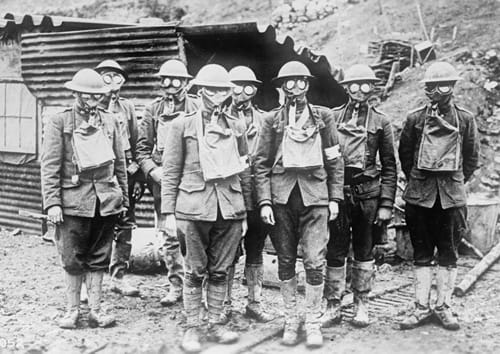
William Collins detailed the rudimentary methods used by soldiers to counteract the gas.
One day, supplies of the first “gas masks” appeared at noon. And all it was a four-by-two-inch wool pad wrapped in gauze with an elastic band going around it. The elastic rose over the head after fitting over the mouth and nose. However, he discovered that after a few minutes of using it in the gas cloud, one was unable to breathe, so it was pulled up over the brow and the gas was ingested. and could only replace it for brief intervals of time. It was in no way a feasible proposal.
Signaller H Williams and the Allied Front Line
After attacking the Allied front line with gas, the Germans launched infantry assaults. Signaller H Williams recalled the reaction of his battalion. Williams said that they saw a yellow object approaching the gas. They only received a little portion of the advantage; it went somewhat diagonally. Shortly after, they witnessed the Germans launching an assault and approaching in large numbers. They had always been pleased by their training to shoot 15 rounds per minute when they arrived up there. They had no artillery counterfire from their batteries, thus it paid off handsomely back then.
Rifle fire alone was sufficient to halt this attempt. They were having a great time getting their own back and were blasting away. They were impossible to overlook! All of them were next to one another.
British private Harry Cox
Up until the end of May, the Second Battle of Ypres persisted. Harry Cox, a British private, devised a creative strategy to avoid a gas assault earlier that month. Harry Cox claims they gassed them on May 5, 1915. But by ascending a tree, he managed to escape. Naturally, the others all perished in the shallow trenches since gas is heavier than air. They were all stretched out and in excruciating pain there. Of course, many of them fled. There were just five truly fit soldiers remaining; therefore, the battalion was actually completely destroyed.
Lendon Payne, a British sapper
Allied deaths were high despite the Germans’ inability to capitalize on the gas assaults’ success. In the vicinity of the Yser Canal, British sailor Lendon Payne personally observed this. Payne made the decision to get some fresh air and investigate when the gas assault was ended and the all-clear was given. However, when Lendon peered along the bank, he could not believe what he saw. The bank was completely covered in gassed men’s bodies. More than a thousand of them must have existed.
Additionally, there were a lot of bodies in the stream downstream and a little further down the canal side. After being recognized in a location known as Hospital Farm to the left of Ypres, they were progressively collected and placed in a massive mound. The ADMS arrived to provide his report while they were inside, but while he was assessing the situation, a shell detonated, killing him.
Edgar Huggins of the Durham Light Infantry
The Durham Light Infantry’s Edgar Huggins explained how the conflict affected his regiment. He survived it despite not knowing if there was a lot of gas, but he had witnessed many people who either died or were killed by it. Because after they had been in there for five days, they got relieved and when they got back to brigade headquarter, the other side of Ypres, there was only 200 of them who answered roll call. Edgar Huggins was among those who responded to the roll call. He could not express what had happened because there was a body of a lot of men. Although he was first reluctant to make an estimate, he eventually disclosed that between six and seven hundred soldiers had either fallen or been gassed. He had no way of knowing how many people had died.
“The chlorine gas originally used was undeniably cruel, but no worse than the frequent effect of shell or bayonet, and when it was succeeded by improved forms of gas both experience and statistics proved it was the least inhumane of modern weapons,” wrote Sir Basil Henry Liddell Hart, a British soldier, military historian and military theorist, who had been gassed at the Somme in July 1916. Although his categorization of chemical weapons did not become widely accepted in the post-war age, his finding on their ability to cause death or serious injury needs to be discussed.
Even while poets like Wilfred Owen highlighted the agony of troops dying from gas, their suffering was not all that different from that of a lethal stomach wound or shrapnel injury to the head and face. This begs the issue of whether gas’s long-lasting psychological effects were due to its original novelty and the ongoing development of poisons and delivery methods, or if it had a unique ability to evoke panic. An army officer named Charles Cruttwell thought that gas compromised a fundamental survival strategy prior to the development of efficient respirators.
When under artillery fire, a soldier relied on luck and had few, if any, defensive choices. But Cruttwell contended that he could not use the protection of chance when he was exposed to cloud gas, saying that “if the very air which he breathes is poison, his chance is gone: he is merely a destined victim for the slaughter.”Shrapnel, however, could be felt. It could be surgically removed from a wounded soldier’s body, but no doctor could cleanse a man’s lungs, and the general consensus was that once poisons were digested, the respiratory system was permanently damaged.
Although cloud gas’s influence could be evaluated because of its novelty, it became more challenging to separate its impacts on morale from the broader effects of artillery bombardment once chemical weapons like shells and mortar bombs were developed. However, the Allied troops made large investments in the manufacturing of chemical weapons, and if the war had lasted until 1919, output was expected to rise dramatically, indicating that commanders had discovered a specific gas-producing weapon that might cause casualties.
Even while experienced infantry battalions were used to gas, it seems to have spooked troops that were ill-prepared for the demands of trench warfare. The question of whether gas may lower morale more quickly than an artillery bombardment remained undiscovered. It was challenging to compare the psychological effects of these different weapons on front-line troops since gas rounds were intermingled with high-explosive ordnance.
Gas-induced concerns were largely influenced by general cultural themes in addition to the intentional exploitation of surprise and uncertainty. Certain harmful substances, such as phosgene, were difficult for the senses to detect and caused strong residual anxieties of enigmatic, dangerous energies. They tapped on a fundamental human fear of being overrun by a strong, invisible force. Because chemical weapons were unknown, there was room for exaggeration and rumours. Strong emotions that might interfere with the logical assessment of the data and the development of coping strategies were frequently sparked by beliefs about gas.
Related Article: The Cold War’s end and How it impacted International Relations
The fact that gas was a result of science and advanced technology may have heightened fears. Disasters caused by humans are typically viewed as more worrying than those caused by nature. Chemical weapons of World War I were so innovative and widespread that their effects extended beyond respiratory medicine and the veteran community. Colonel H.L. Gilchrist, a US Army physician, wrote in 1928 that “poison gas has been blamed for every conceivable sort of ailment; in fact, there is hardly a functioning organ of the body whose disturbed action either during or since its participation in [the war] but has had the blame for its erratic performance laid to the door.”
References:
https://www.iwm.org.uk/history/first-world-war/how-gas-became-a-terror-weapon-in-the-first-world-war

