
There was so much disorder in Germany after Frederick II that for twenty-three years no Emperor was elected. In 1273 Rudolf, Count of Habsburg, was elected Emperor. A new family- that of Habsburg entered the scene.
The House of Habsburg, also known as the House of Austria, was one of the most powerful dynasties in the history of European and Western civilization. It had its impact throughout Empire during the Middle Ages and early modern people, including the Holy Roman Empire and Spain.
The house derived its name from Habsburg Castle, a fortress built in 1020s in the present-day Switzerland by Radbot of Klettgau, who named his fortress Habsburg. His grandson Otto II was the first to take the fortress name as his name, adding “Count of Habsburg” to his title.
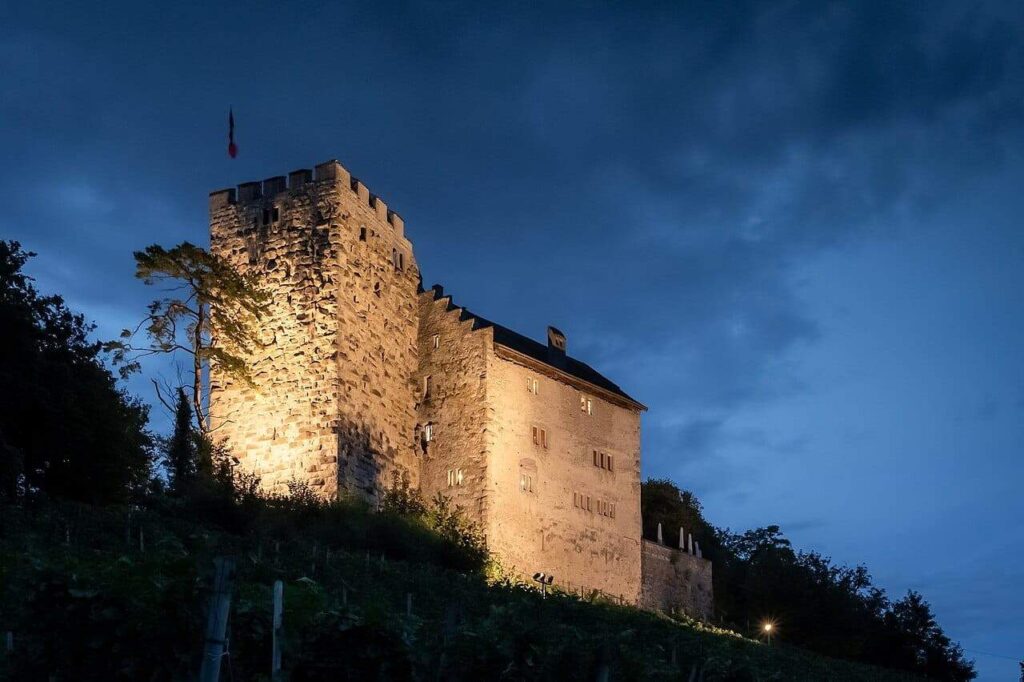
The throne of the Holy Roman Empire was continuously occupied by Habsburgs from 1440 until their extinction in the male line in 1740, like the Habsburg-Lorraine from 1765 until its dissolution in 1806.
The house also produced Kings of Bohemia, Hungary, Croatia, Slavonia, Dalmatia, Spain, Portugal, Sicily, Lombardy-Venetia and Galicia and Lodomeria, with respective colonies; rulers of seven principalities in the Low Countries and Italy; numerous prince-bishops in the Holy Roman Empire, and in nineteenth century, emperors of Austria and of Austria-Hungary, as well as one Emperor of Mexico.
The family split several times into parallel branches, most consequentially in the mid-sixteenth century between its Spanish and German-Austrian branches following the abdication of Emperor Charles V in 1556. Although they ruled distinct territories, the different branches nevertheless maintained close relations and frequently intermarried.
In the sixteenth century kings became supreme, almost all over Europe. In England there were the Tudors, in Spain and Austria the Habsburg. In Russia and in great parts of Germany and Italy there were autocratic monarchs. France was perhaps typical of this kind of King ruling through a personal monarchy; the whole kingdom was being considered almost the personal property of the King.
Related Article: Explain How Socialist Society was Established in Russia
During the sixteenth century, when the Protestant revolt developed some of the kings and princes of Europe sided with one party, some with the other religious motives had little to do with this. It was a mostly a question of politics and the desire for gain. The Emperor of the Holy Roman Empire at that time was Charles V, a Habsburg. Owing to the marriages of his father and grandfather, he happened to inherit a large empire which include Austria, Germany (nominally), Spain, Sicily, the Netherlands, Naples and Spanish America. It was a favourable method in Europe in those days, this way of adding to one’s dominions by marriage. Therefore, Charles V, for no merit of his own, happened to rule over half Europe, and for a while he seemed to be a great man. He decided to side with the Pope against the Protestants. The idea of the Reformation was not in keeping with the idea of empire. But many of the smaller German princes sided with the Protestants, and there were two factions throughout Germany-the Roman and Lutherans. This naturally resulted in civil war in Germany.
In 1520 Charles V became Emperor. Being a Habsburg, he managed to inherit the Kingdoms of Spain, Sicily, Naples and the Netherlands. One might find it strange how the whole countries and people changed masters in Europe because of certain royal marriages. Millions of people and great countries were just inherited. Sometimes they were given as dowries. By careful marriage, thus, the Habsburg gathered together an empire, and Charles V became a head of this. He was a very ordinary man, chiefly noted for eating enormously, however for the moment his great dominions made him seem a colossus in Europe.
In the same year, when Charles V became Emperor, Suleiman became head of the Ottoman Empire. During his reign this empire spread in every direction, especially in eastern Europe. The Turks came right up to the gates of Vienna, but just missed capturing this beautiful old city. But they terrified the Habsburg Emperor, and he thought it expedient to buy off Suleiman by paying him tribute. Some unthinkable or unimaginable followed. The great Emperor of the Holy Roman Empire started paying tribute to the Sultan of Turkey.
In sixteenth century not all the kings had become the boss. For instance, in Switzerland the poor peasants of the mountains had dared to defy the great Habsburg monarch and won their freedom. So, in the European sea of absolution and autocracy, the little peasant republic of Switzerland stood out as an island where kings had no place.
After the Emperor Charles V, Spain and Netherlands went to his son Philip II. Spain at that time towered Europe as the most powerful monarchy.
The Netherlands included both Holland and Belgium. Their very names suggest that they are low lands. Holland comes from hollow-land. Great parts of them are actually below sea level, and enormous dykes and walls have to protect them from the North Sea. Such a country, where one had to fight the sea continually, breeds hardly seafaring folk, and people who crossed the seas frequently took to trade. As a result, the people of the Netherlands became traders. They produced woolen and other goods, and the spice of the East also went to them. Rich and busy cities arose Bruges and Ghent and, especially, Antwerp became in the sixteenth century the commercial capital of Europe. In its house of exchange, it is said that five thousand merchants gathered daily to do business with each other; in its harbour there were as many as two thousand five hundred vessels at one time. Nearly five hundred vessels came to it and went from it every day. These merchant classes controlled the city governments.
This was just the kind of trading community that would be attracted by the new religious ideas of the Reformation. Protestantism spread, particularly in the north. The chances of inheritance made the Habsburg Charles V, and after him his son Philip II, rulers of the Netherlands. Neither of them could tolerate any kind of freedom- political or religious. Philip attempted to crush the privileges of the cities as well as the new religion. The person sent as Governor-General to the Netherlands, who became famous for his oppression, tyranny, and the establishment of the “Blood Council,” was Fernando Álvarez de Toledo, the 3rd Duke of Alba (often referred to in English as the Duke of Alva. Sent by King Philip II of Spain in 1567 to suppress the Dutch Revolt, the Protestant Reformation, and the Iconoclastic Fury, the Duke of Alba instituted a reign of terror.


